

Prayer: Who, Why & How - Ben Bailey
“The effective, fervent prayer of a righteous main avails much” (James 5:16). Since prayer is such an important part of the Chrisitan life, it only makes sense the more I know about prayer the more it can benefit me and those in my prayer life. Here are some basic details Paul gives Timothy about prayer in 1 Tim. 2:1ff…
“The effective, fervent prayer of a righteous main avails much” (James 5:16). Since prayer is such an important part of the Christian life, it only makes sense the more I know about prayer the more it can benefit me and those in my prayer life. Here are some basic details Paul gives Timothy about prayer in 1 Tim. 2:1ff.
The first detail Paul mentions about prayer is “WHO” should mention in prayer. The Christian is told, “Therefore I exhort first of all that supplications, prayers, intercessions, and giving of thanks be made for all men, for kings and all who are in authority, that we may lead a quiet and peaceable life in all godliness and reverence” (1 Tim. 2:1-2). From our family and friends, to our enemies to even those in places of political power, the Christian should be ready to pray for all men.
The next detail Paul mentions about prayer is the “WHY” of prayer. One of the motivations in prayer is “that we may lead a quiet and peaceable life in all godliness and reverence” (1 Tim. 2:2). We have all heard that prayer has powerful results and this verse definitely affirms that truth (James 5:16). Imagine the good we can do for our own lives, the church, and for our country if we only pray. But, we also must imagine the good we will miss out on doing if we don’t have an active prayer life.
The final detail Paul mentions about prayer is the “HOW” of prayer. This aspect of prayer deals with the Christian’s attitude and motivation in prayer. Paul says, “I desire therefore that the men pray everywhere, lifting up holy hands, without wrath and doubting” (1 Tim. 2:8). The idea of lifting up holy hands is indicative of an attitude of a desire to be pure, submissive, and humble before God (See Ps. 24:4). Before we enter into the sacred communication of prayer, may we always examine our hearts and come before God in a manner acceptable to Him! —Ben Bailey

Does it really matter how we worship? - Joey Ferrell
We all should want to worship God. There are enough verses in the Bible to signify the importance, command, inference, and desires of God Himself for us to see that He indeed wants us to worship Him and Him alone!
This week, Kristie and I are at a lectureship in Branson, MO. On the way here from our home, I had several hours to think about an article. At first, as we passed through rural Tennessee and Missouri, some of the “brands” of church buildings caught my eyes and thoughts. I have heard of many of the ones that were seen, but there were some new ones I had not…and I thought that would be an interesting exploration for an article. However, after hearing a very educational lesson during the lectures by Dave Miller, this topic seems much more pressing at this time.
We all should want to worship God. There are enough verses in the Bible to signify the importance, command, inference, and desires of God Himself for us to see that He indeed wants us to worship Him and Him alone! Even in the early days of man, God desired sacrifice - a part of worship. In the days of Noah, Moses, Elijah and the prophets, He described and desired worship. He expected His children to worship Him in the form, fashion, and example as is described throughout.
Think about the tabernacle. The intricacy of design for this particular time in history in which God was to be worshiped. Their were clear instructions from God regarding how and what to use to build it. Then you move to the temple. There were certain items that had to be used in the worship in the temple. While we do not have those types of definitive ideas about our “buildings” and places of worship today, we still have to understand that there is an element that God still designs worship in His own way!
Think about the story in John 4. Jesus meets the woman at the well. They have a discussion. She states that they worshiped in the traditions of their forefathers, but what does Jesus say? Take a look:
“The woman said to Him, “Sir, I perceive that You are a prophet. Our fathers worshiped on this mountain, and you Jews say that in Jerusalem is the place where one ought to worship.” Jesus said to her, “Woman, believe Me, the hour is coming when you will neither on this mountain, nor in Jerusalem, worship the Father. You worship what you do not know; we know what we worship, for salvation is of the Jews. But the hour is coming, and now is, when the true worshipers will worship the Father in spirit and truth; for the Father is seeking such to worship Him. God is Spirit, and those who worship Him must worship in spirit and truth.””
(John 4:19–24)
Jesus said that “all” would worship the way of the Father and not the ways of tradition. It isn’t about the place, or even the various items that we may add through tradition (that are not opposed to the commands of God), but it would be the way God wanted worship that would be accepted!
Fast forward a few decades and guess what happens…we start to see things stray from what God’s design and desire are. Look at what Paul addresses in the letter to the church at Colossi regarding some of the “self-willed” worship that was happening:
“These things indeed have an appearance of wisdom in self-imposed religion, false humility, and neglect of the body, but are of no value against the indulgence of the flesh.”
(Colossians 2:23)
Did you see that? The phrase “self-imposed religion” comes up. Who imposed? SELF. Not God, not Jesus, not even the Apostles in the “Apostles’ Doctrine” as is stated as viable in the book of Acts. Self…men and women deciding what is best for them…emotions…feel-good…lifting-up…praises of men. What a shame!
And, here we are, some almost 2,000 years later and what a mess we might see today. Think of the self-imposed items of the day:
hand-clapping
waving of arms
praise teams
instrumental music
unauthorized leadership roles (women, non-Christians)
statues or other idol types of devices taking “center-stage”
This list could go on and on with the variants of what man has decided that he knows better what God wants than what God knows it would seem. Why? Because it makes them feel good. It helps draw a crowd. It doesn’t offend people. It is what “everybody else” is doing. Yet, it is NOT what God has designed.
When Jesus told the Samaritan woman that worship would be in spirit and in truth, He was not saying it would be spirited to help aid truth. He said IN Spirit and IN Truth. We have no right to speak on behalf of God to add these types of things to our worship to “make us feel good!”
The idea comes up often about Nadab and Abihu submitting unauthorized fire as an example of adding to the worship of God…and rightly so. These men were told how to get the fire, what type of fire, and what to do with it…and they ignored God. Why? Maybe it was inconvenient to get what was required…maybe it was quicker…maybe they felt like it didn’t really matter. Boy were they wrong!
Worship to God matters. It matters when we do it, how we do it, and what we do it with.Let’s be men and women of God and respect His authority and not our own desires. Souls will be in the same punishment as Nadab and Abihu for their disobedience to God. Let’s put aside the “feel-good” ideas and just worship God the way He wants.
To paraphrase something that Dave Miller said - “If someone is bored with the worship designed by God in the Bible, the problem is with the person and not the Bible!”
You can view this lesson by Dave Miller that was delivered at the 8th annual Show Me State Lectures here.
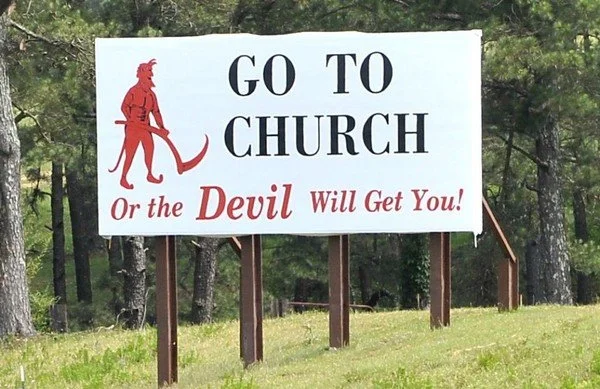
"Go to church or the devil will get ya!" - Joey Ferrell
Go to church or the devil will get ya! Well….sort of. I remember passing this sign probably 10-11 years ago coming back from a family trip to Florida. We were on I-65 north just outside of Montgomery. We had stopped at this sweets store that had a pink cow…yes, a real pink cow (It closed a few years afterwards) and had been laughing about that for miles…and then…there it was! I was like “WOW, did you see that sign?”
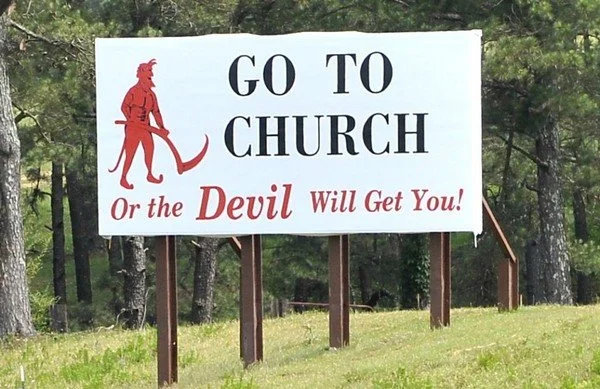
*Disclaimer: I do not own this sign or this image. It was found on the internet with dozens of others taken on I-65 North just outside of Montgomery Alabama.
Go to church or the devil will get ya! Well….sort of. I remember passing this sign probably 10-11 years ago coming back from a family trip to Florida. We were on I-65 north just outside of Montgomery. We had stopped at this sweets store that had a pink cow…yes, a real pink cow (It closed a few years afterwards) and had been laughing about that for miles…and then…there it was! I was like “WOW, did you see that sign?”
The sign was originally placed at this locaton by a local “Christian and Patriot” businessman using a metal devil from a former gas station in Prattville according to an article also found on the internet. It was toppled in a storm in 2016 and remained down until 2019 when it made a new appearance. It still stands today with the sons of the creator maintaining it. It catches a lot of attention and has been shared on social media sites for years.
Enough about the sign though…let’s get to the message! Let’s dissect it a bit:
“Go to church” - the world sees this as a valid statement. Even those in the church will use the phrase often. I am just as guilty in tradition as most others are too. But, we need to think about this a bit. We ARE the church. Certainly, we go to be WITH the church, and the semantics of the phrase can certainly make sense thinking about it that way.
In Acts 2, the Bible says that about 3,000 were added to “the church” and they continued steadfastly in the apostles’ doctrine - and it said that they met daily from house to house.
Throughout Acts, we see the church growing because they were hearing the truth and being added to the church…and then they would go AS the church.
When Paul instructed Timothy and Titus, and others, they were told to go TO the church in different areas, and of course, John records the words of Jesus TO the churches in Asia, each identified geographically.
So…in reality, we go WITH the church, TO the church and semantically TO church.
But what is there about “going to church” that will keep the devil from getting you? Well, nothing really…or almost nothing…with the wrong attitude at least. Hebrews 10:19-25 gives us a very good reasoning why we should come together. Ephesians 4 talks about the varying roles of those in the church and how the function of the teaching of the church is to increase growth, edify the saints, and strengthen our faith.
So, how does that keep the devil from getting you? Well, it doesn’t, but it does make it much harder as you are surrounded by like-minded people that care about your soul when you are with the saints of the church. In the book of Job, the devil was said to have been going to and fro across the earth. He is seeking those who he can devour, so how do we stop him from getting us? We increase our faith, we draw near to God, we flee from the devil, and what better way to do that than to be with the church?
While it is true that many feel that technology has opened new doors in “going to church,” but truly, there is nothing like being with the saints, worshiping, singing, praying together, communing, getting and giving handshakes and hugs, crying with one another, rejoicing with one another and lifting one another up as is described in Hebrews 10.
Maybe you or someone you know needs a little encouragement….let me invite you to “go to church” and find that encouragement. These are our people. They love you and me. They need you and me. And we need them!
Go to church…..or the devil will get you!
Was that a visitor? - Parker Webster
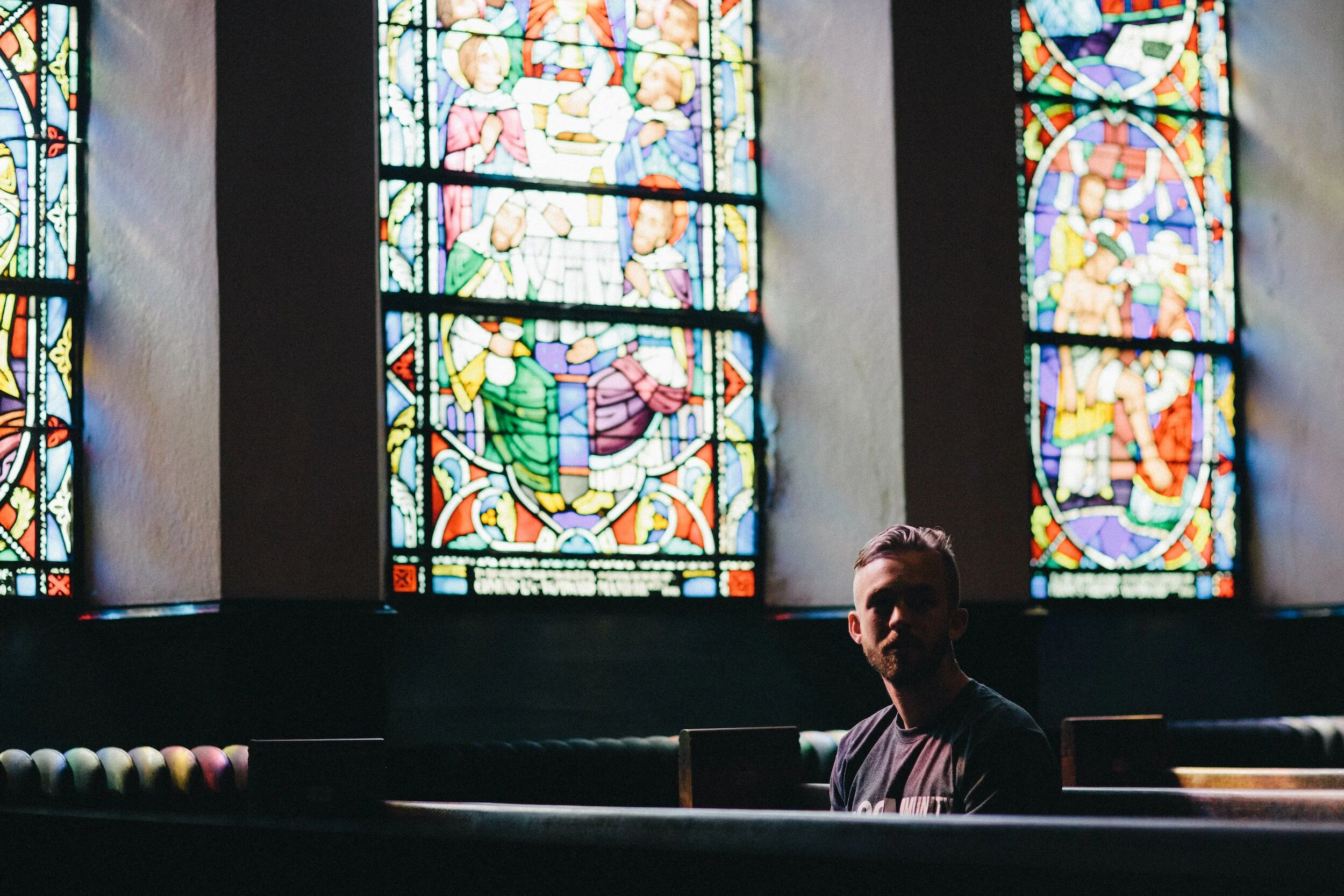
How do outsiders feel in our assemblies? A new assembly and a new type of worship is intimidating. Do we realize our visitors have taken a great step of courage to walk into worship?
(This was an article posted on Facebook, used with permission - title given by TGOC)
Was that a visitor?
How do outsiders feel in our assemblies? A new assembly and a new type of worship is intimidating. Do we realize our visitors have taken a great step of courage to walk into worship?
One of the worst things we can do to that shocked, newly challenged visitor is to ignore their presence. Many will leave in a daze having experienced a new way to serve God while not making any personal connections.
About a week ago, I learned a much needed lesson. I was a visitor. I knew what to expect from the worship and teaching. However, on this occasion my family was COMPLETELY ignored. This wasn’t some back row dash after worship. We sat near the front, took notes, and all sang out. Not a word spoken, not even a handshake. We were all very discouraged.
My family will be fine—we have amazing church families back home, we are saved, and we are deeply connected to the work of the Kingdom.
What about that visitor? What will they think? How will they feel? Will they ever darken the doors again?
We may only have one shot. Get out of your comfort zone. Don’t just stare, go speak to them. Don’t just thank them for coming, ask them about their life. Sit back and listen. Let the love of Jesus shine through you. (Col. 3:15)

God Knows You! - Jameson Steward
“O LORD, You have searched me and known me. You know my sitting down and my rising up; You understand my thought afar off. You comprehend my path and my lying down, And are acquainted with all my ways. For there is not a word on my tongue, But behold, O LORD, You know it altogether” (Psalm 139:1-4).
God Knows You
“O LORD, You have searched me and known me. You know my sitting down and my rising up; You understand my thought afar off. You comprehend my path and my lying down, And are acquainted with all my ways. For there is not a word on my tongue, But behold, O LORD, You know it altogether” (Psalm 139:1-4).
One of the most significant challenges for anyone who teaches or preaches is that you don’t know some people who are listening all that well. I may know some things about you and try to make an application that I think will be helpful – but sometimes it’s just a shot in the dark.
Very few people – if any – may know of your deepest, darkest struggles with temptation. Few people may know of the difficulties you are facing in your life. Maybe no one on this earth knows about the tears you’ve cried. However, there is One who knows everything that goes on in your life.
David wrote that the LORD had searched him and knew him. This refers to profoundly personal and intimate knowledge. The LORD knew things about David that no one else knew or could have known.
David went on to say that the LORD knew what he was doing – and even knew and understood what he was thinking. David emphasizes that not only does the LORD know what you are doing, but He understands fully why you acted that way. He understands your thoughts, and He understands how you think.
The LORD fully understands and sees the path we are traveling in life, even when we may not be able to see where a particular decision will lead us. Even when you feel alone, He sees you. The LORD is “acquainted with” (or familiar with) all your ways.
David wrote that the LORD knew and understood the words he would say before he even said them. God knows and perfectly understands how your mind works and knows the words that come to your mind before you ever say them. It’s safe to say that the LORD knows us better than we even know ourselves.
The reason the LORD knows everything about us is because He made us. “For You formed my inward parts; You covered me in my mother's womb. I will praise You, for I am fearfully and wonderfully made; Marvelous are Your works, And that my soul knows very well” (Psalm 139:13-14).
Because God knows everything about us and is our Creator, His word ought to be precious to us (Psalm 139:17-18). He tells us everything we need to know (2 Timothy 3:16-17). This is why it is so crucial for preachers and teachers to proclaim God’s word (2 Timothy 4:2). I may not know you all that well – but God does, and His word is precisely what you need to hear.
Jameson Steward

Praying - Amy Lawrence
As I write this, I am thinking how unqualified I am to be discussing something I struggle with myself. Don’t get me wrong, the desire to pray is not the trouble. God’s command to pray is for our benefit, not His, Phil. 4:6-7. The struggle is remembering to talk to God without making it nothing but a check in a box. Communication - real, deep communication - is one of my shortcomings. There is only so much of myself that I let be seen. I have my reasons, but I tend to be reserved in any relationship. Rare is the person that can get me to feel comfortable enough to fully open up. I’ve built that habit in my communication with God as well. When I remember (but not as frequently as I should) that my shortcomings shouldn’t keep me from talking to God, I pray. He knows me better than anybody already. There is nothing that is hidden from Him - not even our insecurities - and He still loves us all. That knowledge makes me speak from my heart to the only One that can see the picture in my head before I utter a single word.
Praying
A Study on Communication
Amy Lawrence
As I write this, I am thinking how unqualified I am to be discussing something I struggle with myself. Don’t get me wrong, the desire to pray is not the trouble. God’s command to pray is for our benefit, not His, Phil. 4:6-7. The struggle is remembering to talk to God without making it nothing but a check in a box. Communication - real, deep communication - is one of my shortcomings. There is only so much of myself that I let be seen. I have my reasons, but I tend to be reserved in any relationship. Rare is the person that can get me to feel comfortable enough to fully open up. I’ve built that habit in my communication with God as well. When I remember (but not as frequently as I should) that my shortcomings shouldn’t keep me from talking to God, I pray. He knows me better than anybody already. There is nothing that is hidden from Him - not even our insecurities - and He still loves us all. That knowledge makes me speak from my heart to the only One that can see the picture in my head before I utter a single word.
As we study together, my desire is that we have a better understanding of prayer that will make us see it for what God intended it to be in our lives and put that into practice. As part of the introduction to this study, let me ask some questions. Does it matter who prays? What should be the quality of our prayers? Where should we pray? How often should we pray? Is there a right or wrong way to pray? The word of God can answer.
Let’s begin with defining the idea of prayer. Before we can define what prayer is, we must first establish what prayer isn’t. It is a common belief that God is this magical force that exists only to grant our wishes. Too many don’t believe or stop believing in God because they pray and think they don’t get an answer, ignoring or dismissing the possibility that God’s answer was “no”. David prayed. God’s answer was no, 2 Sam. 12. He continued to be a servant of God. Jesus prayed. God’s answer was no, Mt. 26. He continued to the cross. Paul prayed. God’s answer was
no, 2 Cor. 12:7-10. He continued in a life of poverty, pain, and peril, 2 Cor. 11:22-29, knowing that it would in the end lead to rest, 2 Tim. 4:6-8. God is not an ATM that fulfills our selfish desires. He is our Creator and knows better than we do what we want and need. Praying is our form of communication with God. It is the avenue created by the Almighty to make our requests known to Him, Phil. 4:6. (Does this mean God doesn’t already know? Absolutely not, Mt. 6:8. He still requires we ASK, Mt. 7:7-8.) It is the method we have of thanking God for giving us what we need - and many times what we want, Col. 3:17, Phil. 4:6, and it is the place our hearts go when we are overwhelmed, Ps. 61:2, Rom. 8:26.
Does it matter who prays? Paul wrote to Timothy that only men are to pray aloud in a worship assembly, 1 Tim. 2:8. Does this mean women cannot pray at all in the assembly? We can pray in worship services - just not out loud, 1 Cor. 14:34. James wrote that the “fervent prayer of the righteous” is the most beneficial, James 5:16…but what about the unrighteous? Recorded in Proverbs 15:29, God’s ear is “far from the wicked”. Isaiah wrote that God “will not hear” the unrighteous, Is. 59:1-2. God told Jeremiah not to pray for Judah, Jeremiah 14:11-12. Why? The answer is found in verse 10. They had no desire to follow God and His commandments, therefore God refused to hear them. It matters who prays. Let’s be clear here, though. We should pray for all; including the unrighteous, that they find their way to God, 1 Tim. 2:1. What God disallowed Jeremiah to pray for (and disallows us today, 1 Jn. 5:16) was for God to forgive the sins of the unrepentant. A person that is made aware of sin and still refuses to make their life right in the sight of God is one who has made the choice to remain beyond reach, Is. 59:1-2, 1 Pet. 3:12.
What should be the quality of our prayers? The quality is as important as the quantity. In my personal experience, my prayers vary. Sometimes it is a brief prayer, Jn. 11:41-42, sometimes it is an intense hour of talking with God, Mt. 14:23-25. I talk differently in private versus leading a prayer in the ladies’ Bible class, i.e. personal details and mannerisms compared with general topics concerning the church as a whole to a public audience. It would not be appropriate for me to make a personal, individual prayer when leading others in prayer, nor should my prayers be routine and practiced to the point of robotic habit, Mt. 6:7. There are many factors to be considered in prayer. First and foremost, the condition of the heart determines if a prayer is received, Ps. 51:15-17. One that has the right kind of heart will keep God’s commandments, 1 Jn. 3:22. Respect and honor are also due the One to whom we speak, Jude 24-25. He has earned it. Emotions also play a large part in the quality of prayers, Phil. 1:3-4, Rom. 15:30, Mk.
14:32-34. My most frequent emotions are joy and thankfulness, Phil. 4:4, Col. 3:15, but there have been times when confusion, frustration, anger, and overwhelming sadness were a part of my prayers. Paul was confused, Acts 9:4-6. Moses was frustrated, Ex. 15:23-26, and angry, Num.
16:12-15. Job was overwhelmed with sadness, Job 3, as was Jesus, Lk. 22:44. What these all have in common is that they talked to God about it. We must remember that we can always talk with God…but sometimes we need help. This is a job for the Helper, Jn. 14:16. Who is this? The Holy Spirit! As Christ intercedes for us through sacrifice, Heb. 7:25-28, the Holy Spirit intercedes for us through prayer, Rom. 8:26-27, Eph. 6:18. Our prayers can be spoken with the assurance that the One listening has all the answers, Rom. 8:28.
Where should we pray? There is no wifi on the planet like prayer. We can pray from anywhere, and there is no interference or disconnection. Solomon prayed from a scaffold, 2 Chr. 6:13. Elijah sat beneath a juniper tree as he talked with God, 1 Kings 19:4. Paul and Silas lifted up prayer while in prison, Acts 16:25. Nowhere is beyond God’s ability to hear, not even our own minds, 1 Sam. 1:9-15. It is no wonder; God is everywhere, 2 Chr. 16:9, Ps. 34:15. (It is up to our good sense to know if where we are is a good place to pray out loud or not.)
How often should we pray? I will first admit that my prayers are not as frequent as they should be. On days when I am on point, I pray intermittently from the time I wake until the time I lay back down to sleep, 1 Thess. 5:17. There is no wrong time to pray and no such thing as praying too much. We must, however, be careful if we are not praying enough.
Is there a right or wrong way to pray?1 Jn. 5:14 “And this is the confidence that we have in him, that, if we ask any thing according to His will, he hears us…” Anything we ask of God must be in congruence with both the will of God and the laws that He has established by which we must live. One cannot pray according to God’s will if one does not know God’s will. Once there exists in Christians a knowledge of the commands and nature of God, this allows us to pray as we ought - fervently, unselfishly, and in accordance with God’s purpose, Lk. 11:1-4.
When we bare our souls to God through prayer regularly, this allows the peace Christ offers to settle in and take up residence in our hearts, Phil. 4:6-7. No such peace is found anywhere else. I hope this study has brought as much enlightenment to your prayer life as it has to mine.

Thanksgiving to God - Ben Bailey
“Enter into His gates with thanksgiving, And into His courts with praise. Be thankful to Him, and bless His name. For the LORD is good; His mercy is everlasting, And His truth endures to all generations” (Psalm 100:4-5). With the recent Thanksgiving holiday upon us, many are counting their blessings. But shouldn’t thanksgiving be an everyday event instead of a once a year holiday. To the child of God, everyday is a day of thanksgiving. But, what should we thank God for?
Thanksgiving to God
Ben Bailey
“Enter into His gates with thanksgiving, And into His courts with praise. Be thankful to Him, and bless His name. For the LORD is good; His mercy is everlasting, And His truth endures to all generations” (Psalm 100:4-5). With the recent Thanksgiving holiday upon us, many are counting their blessings. But shouldn’t thanksgiving be an everyday event instead of a once a year holiday. To the child of God, everyday is a day of thanksgiving. But, what should we thank God for?
“…Proclaim with the voice of thanksgiving, And tell of all Your wondrous works” (Psalm 26:7). Christians should be thankful for all that God has done for them. These works would include: God’s love (Rom. 5:6-8), God’s mercy (Lam. 3:21-22), God sacrifice (Isa. 53:10, Matt. 27:46), and God’s salvation (Eph. 2:8-10). Truly, Christians are the most blessed people in the entire world.
“For every creature of God is good, and nothing is to be refused if it is received with thanksgiving; for it is sanctified by the word of God and prayer” (1 Tim. 4:4-5). The Christian should be thankful for the necessities of life that God provides. God is the one who provides all our needs (Phil 4:19). If we are seeking first God’s kingdom and His righteousness, then all else will be provided for us (Matt. 6:33). Aren’t you thankful you don’t have to worry about such things as where your next meal will come from or what clothes you will wear?
“Let us come before His presence with thanksgiving; Let us shout joyfully to Him with psalms” (Psalm 95:2). In this context the psalmist is elated that He can be in the presence of the God of the Universe. Today, we should be thankful that we are able to have a relationship with God. We should be thankful that we can call Him father (Matt. 6:9). We should be grateful that we are part of His family (1 Tim. 3:15). Truly, it is an awesome privilege to have a relationship with Jehovah!
“ Continue earnestly in prayer, being vigilant in it with thanksgiving” (Col. 4:2). May every day of our lives be filled with prayers of thanksgiving to God. If there is a time when we become unthankful, may we stop for just a moment and think about those who are less fortunate than us. “ I will offer to You the sacrifice of thanksgiving, And will call upon the name of the LORD” (Psalm 116:17).
Does the Name Matter? - Ben Bailey
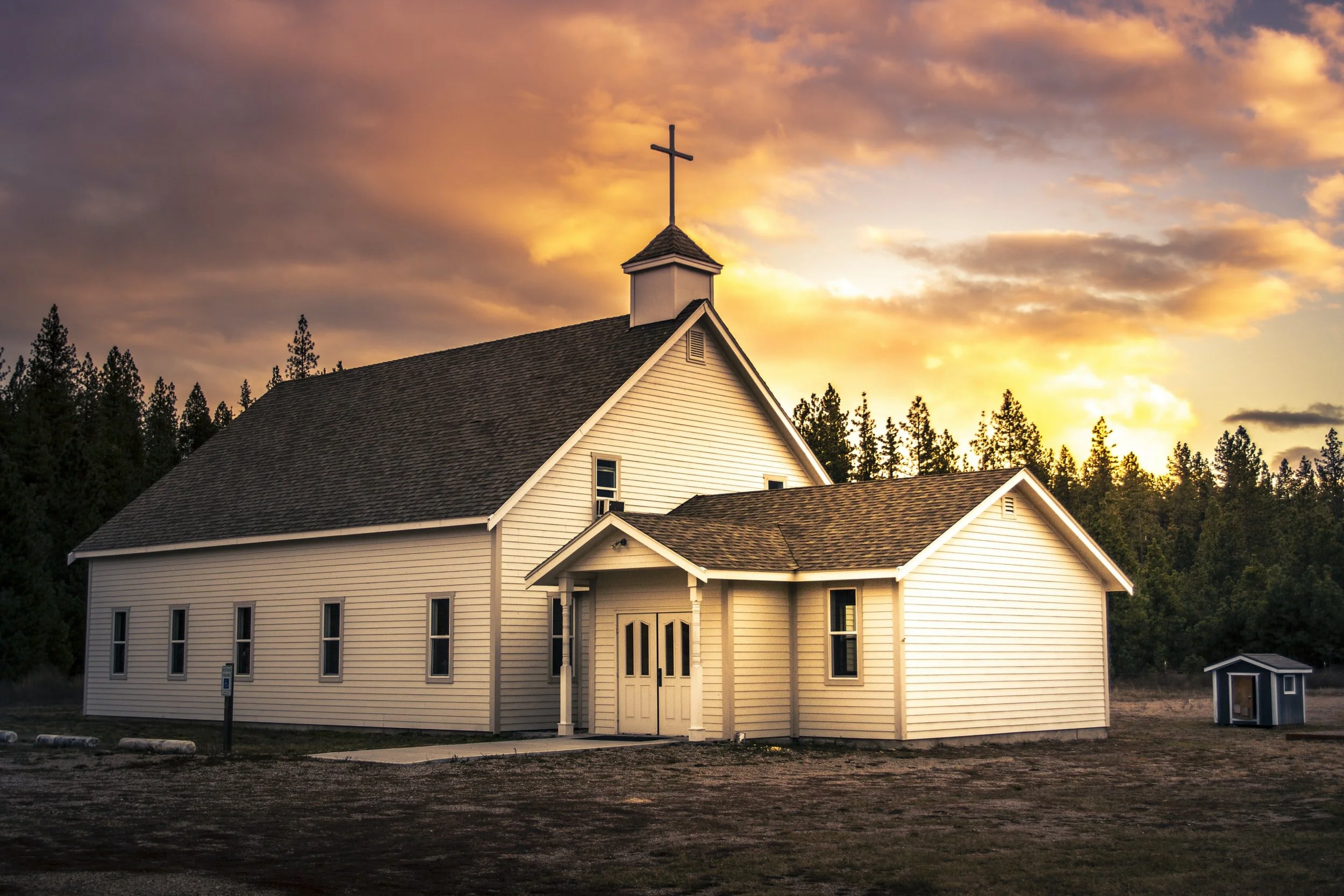
Recently someone told me they thought it didn’t matter what a church called itself as long as they worshipped correctly. Is this true according to the Bible? Could a church called itself any name and be acceptable to God as long as they worship correctly? Let’s consider for a moment why it does matter what the church called itself. In fact, just like worshipping God correctly is essential, going by what the rest of the Bible says about the church is also essential. Notice why this is true.
Does the Name Matter?
Recently someone told me they thought it didn’t matter what a church called itself as long as they worshipped correctly. Is this true according to the Bible? Could a church called itself any name and be acceptable to God as long as they worship correctly? Let’s consider for a moment why it does matter what the church called itself. In fact, just like worshipping God correctly is essential, going by what the rest of the Bible says about the church is also essential. Notice why this is true.
The name of the church is important because the Bible tells us not to add to or take away from God’s Word (Rev. 22:18-19). If the name of a church is not found in the Bible, we would be adding to God’s Word. If the name is found in the Bible and we choose to call it by something not found in the Bible, we would be taking away from it.
The name of the church is important because the Bible specifically tells us not to go beyond what is written (1 Cor. 4:6). If the name of a church is not found in Scripture we are going “beyond what is written.”
The name of the church is important because we are to do everything by the authority of Christ, who is the Head of the church (Col. 3:17; Mt. 28:18; Eph. 1:22-23). Whatever God, Christ or the Holy Spirit referred to the church as is what we should refer to it as.
The name of the church is important because the name we call the church should only bring honor and glory to God, Christ or the Holy Spirit not men (1 Cor. 10:31). If the church is called the church of Mark or Mark’s church, who is that bringing honor to?
The name of the church is important because the Jesus died for and shed His blood for His church (Acts 20:28). The act of Jesus dying on the cross purchased the church. Since it was his blood that paid the price for the church, it should wear His name (Mt. 16:18).
The name of the church is important because the name shows ownership and the Lord as the builder and founder of the church is the only one who has the right to be owner of the church (Mt. 16:13-18).
The name of the church is important because the church is the Bride of Christ and as His bride it should wear His name (Eph. 5:22-31).
The name of the church is important because we are only to speak as the oracles of God (1 Peter 4:11). Here are the names the Bible refers to the church as:
Jesus said, “I will build my church” (Mt. 16:13-18). Thus, it is the church of Jesus or the church of Christ.
It is referred to as the church of the Lord (Acts 20:28).
It is referred to as the church of God in Scripture (1 Cor. 1:1-2; Gal. 1:13)
It is referred to as the church of the Living God (1 Tim. 3:15).
It is referred to as the church of Christ (Rom. 16:16; Gal. 1:22).
It is referred to as the church of the firstborn, which is another name for Jesus (Heb. 12:23; Col. 1:15-19; Rom. 8:29).
The name of the church is important because calling the church by men’s names or denominational names is specifically and explicitly condemned in Scripture (1 Cor. 1:10-13).
Friend, a careful study of the Scripture helps us to see that what we call the church really does matter. We need to call the church by names that are in Scripture and that bring honor and glory to God not men. May God help us to glorify the church Jesus died for in everything we say and do! --Ben Bailey
Article - Prayer, the Essentiality, Manner, and Understanding
In the Gospel accounts, Jesus teaches His disciples about prayer. He was asked a question regarding how to pray, and He answered like this:
“In this manner, therefore, pray: Our Father in heaven, Hallowed be Your name. Your kingdom come. Your will be done on earth as it is in heaven. Give us this day our daily bread. And forgive us our debts, As we forgive our debtors. And do not lead us into temptation, But deliver us from the evil one. Yours is the kingdom and the power and the glory forever. Amen.“For if you forgive men their trespasses, your heavenly Father will also forgive you. But if you do not forgive men their trespasses, neither will your Father forgive your trespasses.” (Matthew 6:9–15, NKJV)
It is interesting to notice the elemental priorities and attributes of this prayer. When it is broken down into basic grammatical statements, we find the following items to consider.
"In this manner" - The phrase "in this manner" shows that prayer is to be purposeful, and meaningful.
"Our Father in heaven, Hallowed be Your name." - The element of the term used to describe the location of the Father in heaven is very significant. This gives us a certainty that God exists and there is a place in which the faithful and obedient will one day live in glory! If God is described as being in heaven and Jesus says in John 14 that "I go there to prepare a place for you," then we must know he means heaven and that place prepared is there and not on this earth or a figment of imagination! The second part of the statement shows honor, respect, and reverence. Some who pray may consider this to be a patterned statement, but it should be more of a characteristic of the humility in which we enter prayer.
"Your kingdom come" - This phrase has caused many an argument in religious discussions. The reference here seems to be the kingdom in which the church is today. With that said, Matthew 16:13, Mark 9:1, Luke 7:27; 24:46, Acts 1-2 all indicate that the kingdom has come and it is truly the church, therefore, when Jesus gave this "model" language, we must realize that this part of His prayer has come into fruition and not necessary to be prayed.
"Your will be done." - Let us always remember that no matter what we ask for, even when Jesus tells His disciples to ask for things in His name (Matthew 21:22), let us realize that we are asking amiss if we are asking for our own benefit and not the will of the Father. (c.f., prayer in Gethsemane)
"Give us this day..." - Notice that there is sort of a disclaimer here. "Give us THIS DAY our DAILY bread." (emphasis JF) When we pray asking, let us not ask for things for the future, but more so for things of today. It is imperative to remember this in our prayer life because this will also give us an indication of how often we should pray...not weekly with the assembly, but at the minimum daily in order to give thanks for our many blessings! Matthew 6:25-34 shows that we can expect to be cared for each day, not worrying about the 'morrow.
"Forgive us our debts....as we forgive others." - Another conjunctive type of clause is found here. Notice that we should ask for forgiveness each time that we pray. Also, note the emphasis, however, that Jesus says "as we forgive others." Does this imply that if we ask for forgiveness, but are unwilling to forgive that we won't be granted? God can only answer that, but the idea seems to be that we must be willing, and praying that we can do just that should give us the courage, boldness, and desire to seek, ask, and to offer forgiveness. In the last part of the teaching of prayer we see that balance given and an emphasis placed.
"lead us not into temptation, and deliver us from the evil one." - How can we overcome sin? Ask for help. The Bible states that no man will be overtaken by a sin that God has not given a way of escape (1 Cor 10:13). It would seem sort of challenging if this were a prayer that Jesus would offer for Himself as he asks to deliver from temptation; however, if you think about the setting of the temptations that Christ endured and overcame, He always references back to God the Father and His word. Some like to think that the phrase heard "guide, guard, and direct" comes from this idea, and maybe so. The emphasis is that we need help to overcome evil and that help comes from God...and we need to focus on asking for that help and not just expecting it.
"Yours is the kingdom, the power, and the glory forever. Amen" - Closing out with another point of reverence and realizing the "net worth" of the avenue of prayer should be an essential part of our prayer life. God is the grantor of all blessings (James 1:17). His power is seen in the creation and in the world in which we live (Job 26:7-14). He is worthy of our praise, honor and glory (Revelation 4:11).
We hope that this discussion on prayer will help each of us to understand the significance - essentiality and manner - of a good prayer life with God the Father through Jesus Christ. Prayer can be vain and it can be mundane if we are not careful. Our prayer life needs to be such that when we ask as we have been told, that we give the reverence and thanksgiving due to our God and Father in all things for His glory.
Joey Ferrell
Bible Class Curricula - Denominational Doctrines (Part 1) - Lesson #4 - The Mennonite Religion
- Introduction
- When did this denomination start? 1525
- Where did it start? Zurich, Switzerland
What is a Mennonite? The official statement of the Mennonite Church (USA) is:
Mennonites are a Christian faith group that began in the 16th century. Currently there are over one million members world-wide. Mennonite beliefs and practices vary widely, but following Jesus in daily life is a central value, along with peacemaking. Menno Simons was an early prominent leader and eventually the group became known as “Mennonites” because of his name.1
There are about 1.7 million Mennonites worldwide (as of 2012).2
- Who founded this religion, and where did the name “Mennonite” originate? The most widely recognized founder was a Catholic priest by the name of Menno Simons who left Catholicism and began the Mennonite religion; as stated in the above point, they officially state that the name “Mennonite” comes from Menno Simons.3
- Who is the head of the Mennonite religion? Jesus is claimed as the Head of the Mennonite church. However, there are large numbers of conferences that take place in the Mennonite church (see the next outline point).
- What is their authority? The Bible – and what is voted on at the various conferences.
- Are the Mennonite and Amish religions different branches of the same belief? Yes. Both came from the Anabaptist radical reformation in the 16th century.
- Mennonite Doctrines Examined
- Concerning salvation:
- The Mennonite Confession of Faith states, "We receive God’s salvation when we repent of sin and accept Jesus Christ as Savior and Lord."4 The Confession of Faith further states, "Our response includes yielding to God’s grace, placing full trust in God alone, repenting of sin, turning from evil, joining the fellowship of the redeemed, and showing forth the obedience of faith in word and deed."5
- The Scriptures teach that belief and repentance must be combined with confession and baptism in order to receive salvation (Matthew 10:32-33; Luke 13:3; John 8:24; Acts 2: 38). Why, according to Mennonite doctrine, are belief and repentance necessary, but confession and baptism are not?
- Concerning baptism:
- The Mennonite church proclaims, "We believe that the baptism of believers with water is a sign of their cleansing from sin. Baptism by water is a sign that a person has repented, received forgiveness, renounced evil, and died to sin, through the grace of God in Christ Jesus."6
- Jesus and His apostles taught that baptism was for the forgiveness of one’s sins and that it was performed prior to salvation (Acts 2:38; Mark 16:16; Acts 22:16; 1 Peter 3:21; Galatians 3:27).
- The frequency of the Lord’s Supper is left up to each congregation’s discretion.
The Mennonite Conference statement says:
The practice of the early church was to celebrate the Lord’s Supper frequently, every Lord’s day or even daily (Acts 2:46). The Anabaptists in the sixteenth century also shared the Lord’s Supper often as a sign of their renewed covenant with God and each other. Our churches are encouraged to celebrate the Lord’s Supper frequently, so that they may participate in the rich meanings of this event for the worship and life of the church.7
- Do the Scriptures authorize our taking the Lord’s Supper daily (Acts 2:46)? No, they do not. The New Testament authorizes the Lord’s Supper to be taken only on the first day of the week (Acts 20:7; 1 Corinthians 16:1-2; Exodus 20:8).
- Many Mennonite congregations practice foot washing on a congregational level.
- The Confession of Faith in a Mennonite Perspective says, "Congregations are encouraged to practice foot washing when it is a meaningful symbol of service and love for each other. "Washing the feet of the saints" (1 Timothy 5:10) is one way of representing Christ to each other in acts of hospitality, service, and love."8
- Is foot washing sinful? No. Yet, in the New Testament, it was practiced on an individual (not congregational) level as an act of humility toward one’s fellow man (John 13:1-30).
- Concerning salvation:
Study Questions
- Compare the origin, date, place, and founder of this denomination with the New Testament blueprint. Does this denomination’s blueprint match that of the New Testament?
- Whose name does the Mennonite church carry? Is this biblical? What passages clearly condemn the practice of naming the church after another man?
- The Mennonite Confession of Faith states that a person can be saved when he repents of sin and accepts Jesus as Lord. What passages prove this is not all you have to do to be saved?
- Mennonites believe that baptism is only a sign of one’s faith and cleansing from sin. List and discuss passages that prove this doctrine false.
- Do you find it odd that the Mennonites left the Catholic church as “rebaptizers” yet they don’t even believe baptism is essential to salvation? Isn’t there a contradiction in this thinking somewhere?
- Does the statement, "The practice of the early church was to celebrate the Lord’s Supper frequently, every Lord’s day," not tell us something about their view of Bible Authority? How can one make a statement like this and not follow through with the implications of that statement?
- What passages and principles teach the Lord’s Supper is to be observed on every first day of the week?
- Is foot washing an act of worship? If not an act of worship, what was the purpose of foot washing? What would be wrong with having foot washing in worship today?
- In the New Testament, was foot washing an individual or congregational activity?
References
- Online: (http://www.mennoniteusa.org/about/who-are-the-mennonites/), retrieved Tuesday, March 25, 2014 .
- Online: (http://www.mwc-cmm.org/article/world-directory), retrieved Tuesday, March 25, 2014 .
- Hugo McCord, What About the Mennonite Church?, Haun Publishing Company, Pasadena, TX.
- Confession of Faith in a Mennonite Perspective, 1995, Online: (http://www.mcusa-archives.org/library/resolutions/1995/1995-8.html).
- Ibid.
- Mennonite Confession of Faith, Article 11.
- Online: (http://www.mcusa-archives.org/library/resolutions/1995/1995-12.html), Commentary note 4.
- Online: (http://www.mcusa-archives.org/library/resolutions/1995/1995-13.html), Commentary note 3.

The Gospel of Christ
This material is copyrighted by The Gospel of Christ and its authors. This information is free to use in its entirety without further consent, however, modifications should not be made without contacting mail@thegospelofchrist.com for permission. Any and all images contained herein are believed to be free for all distribution and content.
Bible Class Curricula - Denominational Doctrines (Part 1) - Lesson #2 - The Greek Orthodox Religion
- Introduction
- The Greek Orthodox religion claims 5 million adherents in the United States.
- Orthodoxy represents a split among differing Catholic thinkers.
- History of the Greek Orthodox Religion
How did Orthodoxy begin? It began as a schism when Catholicism of the east and Catholicism of the west clashed. The Greek Orthodox Archdiocese of America cites the following facts as contributing to the beginning of Orthodoxy:
The West was concerned with the Passion of Christ and the sin of man, the East emphasized the Resurrection of Christ and the deification of man. While the West leaned toward a legalistic view of religion, the East espoused a more mystical theology. Since the Early Church was not monolithic, the two great traditions existed together for more than a thousand years until the Great Schism divided the Church. Today, Roman Catholics and Protestants are heirs to the Western tradition, and the Orthodox are heirs to the Eastern tradition.1
- When did Orthodoxy begin? On July 16, 1054 , Cardinal Humbert, the head of a papal delegation, sent excommunication of Cerularius for the removal of the filioque2 from the Creed; the practice of married clergy; and liturgical errors. The date of 1054 is the traditional date marking the beginning of the schism and the excommunication of Patriarch Michael Cerularius by papal legates.
- Where did the Orthodox religion begin? Constantinople.
- Where is the headquarters of the Orthodox religion? There is none.
- Who is the head of the Orthodox religion? Orthodoxy says, "Each Church is led by a synod of bishops. The president of the synod is known as the Patriarch, Archbishop, Metropolitan, or Catholicos. Among the various bishops, the Ecumenical Patriarch of Constantinople is accorded a "place of honor," and is regarded as "first among equals.""3
- What is their authority? The Orthodox Church has two sources of authority: Holy Scripture and Holy Tradition. Orthodoxy defines tradition as follows: "Holy Tradition, of which Holy Scripture is a part, includes the writings, teachings, Acts of the Apostles, saints, martyrs, and fathers of the Church, and her liturgical and sacramental traditions throughout the ages, the oral tradition of the early Church and the decisions of the Ecumenical Councils."4
- Scriptural Reasons Why I Cannot be a Part of Orthodoxy
- I cannot be a part of Orthodoxy because the Bible is not their only guide (Colossians 3:17; 2 Peter 1:3; Matthew 28:18). The Orthodox Church lists these nine sources as authoritative: Revelation, Tradition, Bible, The Liturgy, The Councils, The Fathers, The Saints, Canons, and Church Art.5
Their belief in tradition is in conflict with what Jesus taught about manmade doctrine (Matthew 15:79; Revelation 22:1819; 1 Corinthians 4:6). The Orthodox religion claims:
Holy Tradition is, therefore, that which is passed on and given over within the Church from the time of Christ’s apostles right down to the present day. … Holy tradition is … the total life and experience of the entire Church transferred from place to place and from generation to generation. Tradition is the very life of the Church itself as it is inspired and guided by the Holy Spirit.6
The Orthodox religion puts trusts in the councils of men instead of the counsels of God (2 Timothy 3:1617; 2 Peter 1:19-21; Proverbs 28:26). Concerning this, those in Orthodoxy state:
The dogmatic definitions [dogma refers to "official teachings"] and the canon laws of the ecumenical councils are understood to be inspired by God and to be expressive of His will for men. Thus, they are essential sources of Orthodox Christian doctrine.
Seven councils are the most revered today. They are as follows:
CouncilYearDoctrinal Result
Nicea I325Formulated the First Part of the Creed, defining the divinity of the Son of God
Constantinople I381Formulated the Second Part of the Creed, defining the divinity of the Holy Spirit
Ephesus431Defined Christ as the Incarnate Word of God and Mary as theotokos
Chalcedon451Defined Christ as Perfect God and Perfect Man in One Person
Constantinople II553Reconfirmed the Doctrines of the Trinity and of Christ
Constantinople III680Affirmed the true humanity of Jesus by insisting upon the reality of His human will and action
Nicea II787Affirmed the propriety of icons as genuine expressions of the Christian Faith
- I cannot be a part of the Orthodox religion because of the religion’s exaltation of certain “saints.” Concerning these saints, those in Orthodoxy state, "The point has been rightly made that men can learn almost as much about the real meaning of Christianity from the legends of the saints produced within the tradition of the Church as from the authentic lives themselves."7 Jesus clearly taught that we are not to inappropriately honor or worship other humans (Matthew 4:10; Revelation 19:10; Philippians 2:5; 1 Peter 2:21ff.). [Question: What is the difference between the "legends" of the saints and their actual lives?]
- Orthodoxy is not a part of New Testament Christianity because of its icons, which are in essence idols. Concerning these icons, the Orthodox Church says, "The icon is Orthodoxy’s highest artistic achievement. It is a gospel proclamation, a doctrinal teaching and a spiritual inspiration in colors and lines."8 Much is said in the Bible about the worship of images (1 Corinthians 12:2; 1 Thessalonians 1:9; 1 John 5:21). [Question: How is an icon like an idol?]
- Orthodox beliefs of theistic evolution are not in line with the biblical view of Creation. Concerning their belief in theistic evolution, those in Orthodoxy state, "God, however, did not create everything individually and all at once, so to speak. He created the first foundations of existence, and then over periods of time (perhaps millions of years, see 2 Peter 3:8)."9 The doctrine of seven literal days of creation, however, is clearly seen in the "morning and evening" language of Genesis 1 and Exodus 20:11. [Question: What is wrong with believing that God used evolution to create the world?]
- I cannot be a part of the Orthodox religion because of Orthodoxy’s belief in original sin (Matthew 18:15; Ecclesiastes 7:29; Ezekiel 28:15).
Orthodoxy cannot be a part of New Testament Christianity because of its emphasis upon the “church building” as a fundamental part of the religious experience:
The church building is patterned after the image of God’s Kingdom in the Book of Revelation. Before us is the altar table on which Christ is enthroned, both as the Word of God in the Gospels and as the Lamb of God in the eucharistic sacrifice. Around the table are the angels and saints, the servants of the Word and the Lamb who glorify him – and through him, God the Father – in the perpetual adoration inspired by the Holy Spirit. The faithful Christians on earth who already belong to that holy assembly – " … fellow citizens with the saints and members of the household of God … " (Ephesians 2:19) – enter into the eternal worship of God’s Kingdom in the Church. Thus, in Orthodox practice the vestibule symbolizes this world. The nave is the place of the Church understood as the assembly and people of God. The altar area, called the sanctuary or the holy place, stands for the Kingdom of God.10
Study Questions
- What factor(s) led to the formation of the Greek Orthodox denomination?
- When did this denomination begin? Who founded it? Where was it founded? Is all of this in accord with the beginning of the New Testament church?
- What is wrong with this group’s sources of authority?
- Do the Scriptures teach that the definitions and canon laws of ecumenical councils are inspired by God? Why would someone make this kind of statement?
- What is wrong with tradition being the life of the church?
- Can men learn as much from the "legends" of the saints as they can from the "lives" of the saints? What does the term legends imply?
- Is there anything wrong with having an icon? Discuss how this relates to people wearing crosses or having angel figurines in their houses.
- What does the Greek Orthodox denomination believe about creation? Do the Scriptures teach theistic evolution?
- Discuss Ezekiel 28:18 and original sin.
- Is a “church building” essential to New Testament Christianity? Is it sinful? At what point does it cross the line between expedient and sin?
References
- Online: (http://www.goarch.org/ourfaith/ourfaith7052), retrieved on Tuesday, March 25, 2014 .
- The filioque is a heavily disputed part of the Nicene Creed that forms a divisive difference in particular between the Roman Catholic and Eastern Orthodox traditions. In the Orthodox tradition, the line in question reads, "We believe in the Holy Spirit … who proceeds from the Father," while in the Catholic tradition it reads, "We believe in the Holy Spirit … who proceeds from the Father and the Son." It is most often referred to as simply "filioque" or "the filioque."
- Online: (http://www.goarch.org/ourfaith/ourfaith7052), retrieved on Tuesday, March 25, 2014 .
- Online: (http://www.goarch.org/ourfaith/ourfaith8032), retrieved on Tuesday, March 25, 2014 .
- Thomas Hopko, The Orthodox Faith, Volume 1 (Doctrine), Online: (http://www.oca.org/OCIndex-TOC.asp?SID=2&book=Doctrine§ion=Sources%20of%20Christian%20Doctrine).
- Online: (http://www.oca.org/OCchapter.asp?SID=2&ID=2), retrieved on Wednesday, February 08, 2006 .
- Online: (http://www.oca.org/OCchapter.asp?SID=2&ID=7), retrieved on February 08, 2006 .
- Online: (http://www.oca.org/OCchapter.asp?SID=2&ID=9), retrieved on February 08, 2006 .
- Online: (http://www.oca.org/OCchapter.asp?SID=2&ID=13), retrieved on February 08, 2006 .
- Online: (http://www.oca.org/OCchapter.asp?SID=2&ID=43), retrieved on February 08, 2006 .
The Gospel of Christ
This material is copyrighted by The Gospel of Christ and its authors. This information is free to use in its entirety without further consent, however, modifications should not be made without contacting mail@thegospelofchrist.com for permission. Any and all images contained herein are believed to be free for all distribution and content.
Bible Class Curricula - Denominational Doctrines (Part 1) - Lesson #13 - The Nazarene Religion
- History of the Nazarene Denomination
- When did the denomination start? October 1895
- Where did this movement start? Los Angeles, California
How did this movement start? The Nazarene religion began as a means of helping the poor and needy.
In October 1895 , Phineas F. Bresee, D.D., and Joseph P. Widney, M.D., with about 100 others … organized the Church of the Nazarene at Los Angeles. They believed … that their expenditures of time and money should be given to Christlike ministries for the salvation of souls and the relief of the needy. They organized the church accordingly. They adopted general rules, a statement of belief, a polity based on a limited superintendency, procedures for the consecration of deaconesses and the ordination of elders, and a ritual. These were published as a Manual beginning in 1898 . …
The Year of Uniting: 1907 – 1908 . The Association of Pentecostal Churches of America, the Church of the Nazarene, and the Holiness Church of Christ were brought into association with one another by C. W. Ruth, assistant general superintendent of the Church of the Nazarene, who had extensive friendships throughout the Wesleyan-holiness movement. Delegates of the Association of Pentecostal Churches of America and the Church of the Nazarene convened in general assembly at Chicago, from October 10 to 17, 1907 . … Further, the General Assembly adopted a name for the united body drawn from both organizations: The Pentecostal Church of the Nazarene. …
The second General Assembly of the Pentecostal Church of the Nazarene met in a joint session with the General Council of the Holiness Church of Christ from October 8 to 14, 1908 , at Pilot Point, Texas. The year of uniting ended on Tuesday morning, October 13 , when R. B. Mitchum moved and C. W. Ruth seconded the proposition: "That the union of the two churches be now consummated." At 10:40 a.m. , amid great enthusiasm, the motion to unite was adopted by a unanimous rising vote.
Denominational Change of Name. The General Assembly of 1919 , in response to memorials from 35 district assemblies, officially changed the name of the organization to Church of the Nazarene because of new meanings that had become associated with the term "Pentecostal."
… After 1908 various other bodies united with the Church of the Nazarene.1
- Who founded the Nazarite religion? Phineas F. Bresee. He founded this movement with its motto being "Let the Church of the Nazarene be true to its commission; not great and elegant buildings, but to feed the hungry and clothe the naked, and wipe away the tears of sorrowing, and gather jewels for His diadem."2
- Who is the head of the Nazarene denomination? While no one person is considered to be the head, the Nazarene movement recognizes the need for a “head” when they say, "We are agreed on the necessity of a superintendency that shall complement and assist the local church in the fulfilling of its mission and objectives. The superintendency shall build morale, provide motivation, supply management and method assistance, and organize and encourage organization of new churches and missions everywhere."3 This “superintendency” is visible in the form of a General Assembly conference and preamble. The current General Superintendent is Paul Cunningham.
- What is their Authority? The Bible and the Church of the Nazarene Manual, including their 16 Articles of Faith.
- Nazarene Doctrines Examined Scripturally
- Divine Healing
- One of the major doctrines of the Nazarene movement is divine healing. Concerning this belief, the Church of the Nazarene Manual says, "We believe in the Bible doctrine of divine healing and urge our people [to seek](sic) to offer the prayer of faith for the healing of the sick. We also believe God heals through the means of medical science."4
- The idea of "divine healing" is not a twenty-first-century phenomenon. It is something that occurred in the first century for a specific purpose and with a specific end in sight (Mark 16:20; Hebrews 2:3-4; Acts 8:18; 1 Corinthians 13:8-10; James 1:25; Zechariah 13:2).
- Baptism
The Nazarene denomination differs greatly from Scripture on baptism. Nazarenes state:
Baptism being a symbol of the new covenant, young children may be baptized, upon request of parents or guardians who shall give assurance for them of necessary Christian training.
Baptism may be administered by sprinkling, pouring, or immersion, according to the choice of the applicant.5
- The Scriptures do not teach that young children need to be (or can be) baptized (Isaiah 7:16; Matthew 18:3; John 8:24: Romans 7:1-4; Luke 13:3). Also, the mode of baptism in Scripture is performed only by immersion (Mark 1:9-10; John 3:23; Acts 8:37ff; Romans 6:1-4; Colossians 2:12).
- Justification, Salvation
- The Nazarene denomination says: "We believe that justification, regeneration, and adoption are simultaneous in the experience of seekers after God, and are obtained upon the condition of faith, preceded by repentance."6
- While faith and repentance are necessary, they alone will not save (James 2:24; Mark 16:16; Acts 2:38; Acts 18:8).
- Women Preachers/Leaders
The Nazarene Church Manual says:
The Church of the Nazarene supports the right of women to use their God-given spiritual gifts within the church and affirms the historic right of women to be elected and appointed to places of leadership within the Church of the Nazarene, including the offices of both elder and deacon.7
- It is clear from Scripture that women are not to be placed in leadership positions (1 Timothy 2:8-11; 1 Corinthians 14:34ff; 1 Corinthians 11:1ff).
- Religious Name
- The Nazarene religion affirms that the name "Nazarene" is approved by God in Acts 24:5.
- Question: Is the name "Nazarene" approved by God for followers of Christ? Or, was this name given as a term of derision by the enemies of Christ?
- Divine Healing
Study Questions
- What is wrong with October 1895 ; Los Angeles, CA; Phineas F. Bresee; and Paul Cunningham?
- The Nazarene denomination is a culmination of bits and pieces of four religious organizations. List those denominations and explain how each group contributed.
- Is a desire to feed the hungry and clothe the poor a reason to start a religious movement? Or, should that duty be performed within the body of Christ? (See Acts 6.)
- What is implied by the term Superintendency? What is wrong with having a General Assembly?
- Explain why it is wrong to have the Bible and a church manual. Support from Scripture.
- Are divine healing and the prayer of faith the same type of healing? Divine healing may solicit prayer, but does the prayer of faith ask/solicit divine healing? See James 5:13.
- What would you do if a family responded to the invitation and wanted to have their two-year-old child baptized?
- What does it mean to allow women to use their spiritual gifts in the church? Do we do that today? Are we inhibiting women from using their gifts by not letting them lead?
- How did Tertullan use the name "Nazarene" in Acts 24:1-5? What is implied by the term "Nazarene"? Were the Jews happy that their Messiah might possibly have come from Nazareth? See John 1:46
References
- Church of the Nazarene Manual ( 2013 – 2017 edition, Nazarene Publishing House, Kansas City, MO, 2013 ), pp. 18–20.
- Online: (http://www.christianitytoday.com/ch/2004/issue82/10.32.html?start=3), retrieved June 2, 2014 .
- Church of the Nazarene Manual ( 2013 – 2017 edition, Nazarene Publishing House, Kansas City, MO, 2013 ), p. 40.
- Ibid., p. 35.
- Ibid.
- Ibid., p. 32.
- Ibid., p. 186.
The Gospel of Christ
This material is copyrighted by The Gospel of Christ and its authors. This information is free to use in its entirety without further consent, however, modifications should not be made without contacting mail@thegospelofchrist.com for permission. Any and all images contained herein are believed to be free for all distribution and content.
Bible Class Curricula - Denominational Doctrines (Part 1) - Lesson #8 - The Methodist Religion
- History of the Methodist Religion
- When did this movement start? 1739
- Where did it start? England
- Where is their official headquarters? The United Methodist Church (UMC) does not have a church headquarters. The structure of the denomination is similar to that of the United States government.1
- Who founded this movement? The sole founder of this movement is John Wesley. Concerning their founder, the UMC states, "May 24, or the nearest Sunday, is Aldersgate Day or Aldersgate Sunday. This celebrates our founder John Wesley’s life-changing experience at a meeting on Aldersgate Street, London, May 24, 1738."2
What is their authority? The Bible, church conferences, and the sermons and commentaries of John Wesley are authoritative. Concerning the pioneers of the UMC and their belief about authority, the Methodist Book of Discipline says:
[T]hey were equally confident that there is a “marrow” of Christian truth that can be identified and that must be conserved. This living core, as they believed, stands revealed in Scripture, illumined by tradition, vivified in personal experience, and confirmed by reason. They were very much aware, of course, that God’s eternal Word never has been, nor can be, exhaustively expressed in any single form of words. They were also prepared, as a matter of course, to reaffirm the ancient creeds and confessions as valid summaries of Christian truth. But they were careful not to invest them with final authority or to set them apart as absolute standards for doctrinal truth and error.3
- Methodist Doctrine vs. Bible Doctrine
- Official Authority
- Methodists have a Book of Discipline that gives the official rules and regulations of the church, along with the church’s articles of faith. This book is man-made.
- The Bible claims that it is our only guide for rules, regulations, and beliefs (2 Timothy 3: 16-17; 2 Peter 1:3; Galatians 1:6-9; Revelation 22:18-19; Acts 2:42).
- Faith and Works
- Methodists teach, "Wherefore, that we are justified by faith only is a most wholesome doctrine, and very full of comfort."4
- The Bible says that faith without works is a dead faith (James 2:24; Luke 6:46; Matthew 7:21; Hebrews 5:8-9; John 3:36).
- Free Will
- Methodists teach, "The condition of man after the fall of Adam is such that he cannot turn and prepare himself, by his own natural strength and works, to faith, and calling upon God" (Article VIII).5
- The Bible teaches that man is a free moral agent and that he can and must call on God out of his own will (Joshua 24:15; Acts 10:34; Galatians 2:6; 1 Timothy 2:4-6).
- Church
- Concerning the church, Methodists believe that "the Christian Church is the community of all believers under the Lordship of Christ."
- The Bible teaches that Jesus built only one church (Matthew 16:18; Ephesians 1:22-23; 1 Corinthians 1:10-13; 12:13; Colossians 2:18).
- Name of Christ
- Methodists believe that there is nothing in a name. Thus, Christians can wear any name they wish.
- The Bible teaches that we must do only that which is authorized (1 Corinthians 4:6; Colossians 3:17; Isaiah 63:19; Micah 4:5).
- Essentiality of Baptism
- Methodists do not believe that baptism is essential to salvation.
- The Bible clearly teaches the essentiality of baptism (Mark 16:16; Acts 2:38; 1 Peter 3:21; Acts 22:16; John 3:5).
- Candidates and Modes of Baptism
- Methodists believe that babies are candidates for baptism and that pouring, sprinkling, or immersion is acceptable (although sprinkling is preferred).
- In the New Testament, baptism (Greek, baptidzo,) is performed only on accountable men and women (Isaiah 7:16; Acts 8:12) only by immersion (John 3:23; Mark 1:9-10; Acts 8:37-42; Romans 6:1-4).
- Abortion
- The Methodist religion approves of abortion in some cases. Their official statement about abortion says, "In continuity with past Christian teaching, we recognize tragic conflicts of life with life that may justify abortion, and in such cases we support the legal option of abortion under proper medical procedures."6
- The Bible does not authorize the taking of an unborn child’s life (Exodus 21:22-25; Jeremiah 1:5; Amos 1:13; Proverbs 6:6-9).
- Alcohol
- The Methodist religion offers contradictory positions regarding the use of alcohol. In one place it is stated, "We affirm our long-standing support of abstinence from alcohol as a faithful witness to God’s liberating and redeeming love for persons." Yet, just four lines down, it is suggested, "with regard to those who choose to consume alcoholic beverages, judicious use with deliberate and intentional restraint, with Scripture as a guide" should prevail.7
- The Bible teaches that a Christian should abstain from every form of evil (1 Thessalonians 5:22; Ephesians 5:18; Proverbs 20:1; Proverbs 23:29-35).
- Women Preaching
The Methodist Manual says that women can preach, teach, and be pastors or bishops:
On May 4, 1956, in Minneapolis, the General Conference of the Methodist Church approved full clergy rights for women. Half a century later, the fruits of that action are the nearly 12,000 United Methodist clergywomen who serve the church at every level, from bishops to local pastors.8
- The Bible teaches that women are to be in a place of submission in the presence of other men, and are not to preach publicly in a mixed audience (1 Timothy 2:8-12; 1 Corinthians 14:34-35; 1 Corinthians 11:3).
- Worship Music
- The Methodist church uses instrumental music in its assemblies. Interestingly, even John Wesley condemned such an action when he wrote, "I have no objection to instruments of music, in our chapels, provided they are neither heard nor seen."9
- The New Testament authorizes only the use of singing for our music (Ephesians 5:19; Colossians 3:16-17; Leviticus 10:1-2; Hebrews 8:13).
- Communion
- Many Methodist congregations partake of the Lord’s Supper only on the first Sunday of each month and on Christmas and Easter.
- In the New Testament, early Christians partook of the Lord’s Supper every first day of the week (Acts 20:7 cf. Exodus 20:8; 1 Corinthians 16:1-2; Acts 2:42).
- Official Authority
Study Questions
- What does it imply when Methodists say, "there is a ‘marrow’ of Christian truth that can be identified and that must be conserved"?
- Why do people often put their faith in men, like John Wesley?
- What is wrong with having a Book of Discipline, Creed, or Confession of Faith?
- While Faith Only may be a comforting doctrine, is it biblical?
- Is there anything in a name? Prove your point from Scripture.
- The Methodist religion teaches that all “believers” are part of the greater Christian church. Is this a biblical idea? Explain your answer.
- Why are babies not proper candidates for baptism? What parts of the plan of salvation can a baby not fulfill?
- Does the Methodist view of abortion condone situation ethics? Discuss what situation ethics is and how to refute it.
- Often times, when men create a religion, it isn’t long until they are found contradicting their own teaching. Such is the case with the Methodist view of alcohol consumption. What motives do you think would cause them to be against alcohol in one place and for it in another?
- Does the New Testament authorize women to preach? Support your answer from Scripture.
- What did John Wesley say about instrumental music? What do the Scriptures say about it?
References
- Online: (http://archives.umc.org/interior.asp?ptid=1&mid=1370), retrieved February 15, 2006.
- Online: (http://www.interpretermagazine.org/interior_print.asp?ptid=1&mid=8838&pagemode=print), retrieved February 15, 2006.
- Patterson, Ronald P., editor, The Book of Discipline of the United Methodist Church, (United Methodist Publishing House, Nashville, TN, 1984,) p. 67.
- Ibid., p. 57.
- Ibid., p. 57.
- Online: (http://archives.umc.org/interior.asp?mid=1732), retrieved February 15, 2006.
- Online: (http://archives.umc.org/interior.asp?ptid=1&mid=1755), retrieved February 15, 2006.
- Online: (http://archives.umc.org/interior.asp?ptid=1&mid=1021), retrieved February 15, 2006.
- Clarke, Adam, Commentary on the Bible, Vol. 4, p. 685.
The Gospel of Christ
This material is copyrighted by The Gospel of Christ and its authors. This information is free to use in its entirety without further consent, however, modifications should not be made without contacting mail@thegospelofchrist.com for permission. Any and all images contained herein are believed to be free for all distribution and content.
Bible Class Curricula - Denominational Doctrines (Part 1) - Lesson #7 - The Baptist Religion
- History of the Baptist Denomination
- When did the denomination start? 1607–1609
- Where did this movement start? London, England
- How did this movement start? This movement began during the Reformation of the sixteenth century. Baptists were originally called Anabaptists and were closely associated with (and even partly indoctrinated by) Menno Simmons, founder of the Mennonite religion. Anabaptists (or Baptists) were considered unique in the Reformation because they believed that those who had been sprinkled as children needed to be re-baptized as adults.1
- Where did the name “Baptist” originate? There is no reference in the Bible to the church ever being called "the Baptist church" (see Romans 16:16). Most likely, Baptists were labeled Baptists because they insisted on the rebaptism of adults who had been sprinkled. (Note: It is a misconception on the part of both Baptists and non-Baptists alike that the name “Baptist” came from John the Baptist.)
- Who founded the Baptist religion? John Smythe, a British separatist who become infatuated with Mennonite teaching.
- Who is the head of the Baptist denomination? Christ is called the Head, but the Southern Baptist Convention (SBC) sets policy concerning faith and doctrine.
- What is their authority? Scripture is claimed to be their guide in all matters. However, tradition and creeds are also very important.
- Baptist Doctrine Examined in Light of Scripture
- Baptists believe that a church can omit certain requirements of the Gospel and yet still be pleasing to God.
- The Standard Baptist Manual says, "A body of Christian disciples may fail to meet some of the requirements of the gospel, and still be a true church of Christ."2
- The Scriptures teach if we leave out any of the requirements of the Gospel, then we are no longer pleasing to God (Revelation 2-3; Matthew 7:21; John 14:15; Revelation 22:18-19; 2 John 9; 1 Corinthians 4:6).
- Baptist doctrine teaches that baptism is a good command of Christ to follow, but that it is not essential to salvation.
- The Standard Baptist Manual says, "Baptism is not essential to salvation, for our churches utterly repudiate the dogma of ‘baptismal regeneration’; but it is essential to obedience since Christ has commanded it."3
- The Scriptures are clear on the essentiality of baptism (Mark 16:16; Acts 2:38; 22:16; 1 Peter 3: 21; Galatians 3:27). (Note: The Scriptures do not teach the idea of baptismal regeneration – i.e., that there is some “mystical power” in the water itself that effects salvation.)
- Concerning the Lord’s Supper, Baptists believe that this is a command of which the time and frequency have been left up to man.
The Standard Baptist Manual says:
As to the time, place, and frequency of the ordinances, no Scriptural directions are given. These are left optional with the churches. They are usually observed on Sundays, but not necessarily. As to the Supper, our churches have generally come to observe it on the first Sunday of each month.4
- An approved example of the day and frequency of the Lord’s Supper is found among first-century Christians (Acts 20:7 cf. 1 Corinthians 16:1-2).
- Baptists believe that to become a part of the Baptist Church, a person must be “voted in.”
For example, the Standard Baptist Manual says:
It is most likely that in the Apostolic age when there was but "one Lord, one faith, and one baptism," and no differing denominations existed, the baptism of a convert by that very act constituted him a member of the church, and at once endowed him with all the rights and privileges of full membership. In that sense, “baptism was the door into the church.” Now, it is different; and while the churches are desirous of receiving members, they are wary and cautious that they do not receive unworthy persons. The churches therefore have candidates come before them, make their statement, give their “experience” and then their reception is decided by a vote of the members. And while they cannot become members without baptism, yet it is the vote of the body which admits them to its fellowship on receiving baptism.5
- To see the scriptural problem with this, one needs to look no farther than Acts 2:38ff. (especially verse 47).
- Baptists believe that in order to be saved, one must “pray to ask Jesus to come into his heart.”
One of the best-known Baptist preachers, Billy Graham, speaks for the majority of Baptists on salvation when he says:
Here is how you can receive Christ: Admit your need (I am a sinner). Be willing to turn from your sins (repent). Believe that Jesus Christ died for you on the cross and rose from the grave. Through prayer, invite Jesus Christ to come in and control your life through the Holy Spirit. (Receive Him as Lord and Savior.)6
The person seeking salvation is then invited to pray this prayer:
Dear Lord Jesus, I know that I am a sinner, and I ask for Your forgiveness. I believe You died for my sins and rose from the dead. I turn from my sins and invite You to come into my heart and life. I want to trust and follow You as my Lord and Savior. In Your Name. Amen.7
- Baptist teaching on salvation is in conflict with the New Testament which teaches that one must do more than most Baptists teach. For example, a person must hear the word (Romans 10:17), believe in Jesus (John 8:24), repent of past sin (Luke 13:3), confess Christ (Romans 10:10), be baptized for the forgiveness of one’s sins (Acts 2:38), and live a faithful Christian life (Revelation 2:10).
- Baptists offer misguided examples of salvation (such as the thief on the cross).
- "Baptists believe that the Bible teaches that baptism is important but not necessary for salvation. For example, the thief on the cross (Luke 23:39-43) … experienced salvation without the necessity of baptism."8
- A thorough study of the Scriptures shows that the thief on the cross is not a good example of salvation for four reasons:
- The argument is based on an unproven assumption that the thief was never baptized (cf. Matthew 3:5-6).
- The thief lived and died under the Old Testament (Hebrews 9:15-17).
- The thief was unable to believe that Jesus had died and risen from the grave because Jesus had not yet died nor risen from the grave (Luke 23:39-46; 24:1ff).
- Jesus had power while on Earth to forgive sins any way He chose (Mark 2:10).
- Baptists employ instrumental music in their worship to God.
However, even the well-known Baptist preacher of the last generation, Charles Spurgeon, wrote in his commentary on Psalm 42:
David appears to have had a peculiarly tender remembrance of the singing of the pilgrims, and assuredly it is the most delightful part of worship and that which comes nearest to the adoration of heaven. What a degradation to supplant the intelligent song of the whole congregation by the theatrical prettiness of a quartet, bellows, and pipes. We might as well pray by machinery as praise by it.
- Also, justification for such a practice cannot be found within the New Testament. Every reference to singing in the New Testament is a cappella (Ephesians 5:19; Colossians 3:16).
- The religious celebration of such holidays as Christmas and Easter is not founded upon the Scriptures; rather, we remember a memorial feast weekly (1 Corinthians 11:26 cf. Acts 20:7).
- Baptists believe that a church can omit certain requirements of the Gospel and yet still be pleasing to God.
- How to Convert a Baptist
- Remind them of the importance of having God’s authority for everything we do in worship and life (Colossians 3:17; Matthew 28:18; 1 Corinthians 4:6).
- Ask them, "If a person were to take the Bible only, would he or she become a Baptist?" Have them explain their answer.
- Teach the fundamental “who, what, when, where, and how” of the New Testament church.
- Look at clear examples where people had to do more than “just believe in Jesus” (e.g., James 2:24; Matthew 7:21-23).
- Discuss the worship of the church as found in the Book of Acts (Acts 2:42).
- Look at passages in the New Testament which teach that baptism is essential to salvation (Mark 16: 16; Acts 2:38; John 3:5; 1 Peter 3:21; Galatians 3:27; Ephesians 1:3; 2 Timothy 2:10).
Study Questions
- Did John the Baptist start the Baptist denomination? Who began this religious movement? What is wrong with John Smythe starting this movement?
- Can a church "fail to meet some of the requirements of the gospel" and still be a true church of Christ? What Scriptures teach we must go exactly by what the Bible says?
- What passages teach baptism is essential to salvation?
- Do the Scriptures teach the idea of baptismal regeneration (i.e., something mystical/magical occurs in the waters of baptism)?
- Are there any Scriptural directions given concerning the time, frequency and place of the Lord’s Supper?
- What is wrong with someone being “voted in” to a religious group? See Acts 2:47.
- Compare Billy Graham’s Plan of Salvation with the Lord’s. What are the differences? Whom would you rather put your faith in?
- Is the sinner’s prayer even found one time in Scripture?
- Why is the thief on the cross not an example of salvation for people today?
- What is wrong with celebrating religious holidays like Christmas or Easter?
References
- Mead, Frank S., Handbook of Denominations (Abingdon Press, Nashville, TN, 1985), p. 35.
- Hiscox, Edward T., The Standard Manual for Baptist Churches (American Baptist Publication Society, Philadelphia, PA, 1951), p. 12, note 1.
- Ibid., pp. 20–21, note 8.
- Ibid., pp. 20–21, note 5.
- Ibid., pp. 22.
- Billy Graham Evangelistic Association, Online: (http://www.billygrahamlibrary.org/PGView.aspx?pid=13), retrieved April 3, 2014 .
- Ibid.
- Online: (http://baptistdistinctives.org/articles/believers-baptism/), retrieved April 3, 2014 .
The Gospel of Christ
This material is copyrighted by The Gospel of Christ and its authors. This information is free to use in its entirety without further consent, however, modifications should not be made without contacting mail@thegospelofchrist.com for permission. Any and all images contained herein are believed to be free for all distribution and content.
Bible Class Curricula - Denominational Doctrines (Part 1) - Lesson #10 - The Seventh Day Adventist Religion
- History of the Seventh Day Adventists
- When did this movement start? 1830 (officially 1843–1844)
- Where did it start? New York/Maine
- Where is their official headquarters? Silver Springs, Maryland1
- Who founded this movement? The movement began with William Miller and was later developed and popularized by Ellen G. White.
What is their authority? Adventists affirm:
The Church Manual has existed in its current format since 1932. It describes the operation and functions of local churches and their relationship to denominational structures in which they hold membership. The Church Manual also expresses the Church’s understanding of Christian life and church governance and discipline based on biblical principles and the authority of duly assembled General Conference sessions. "God has ordained that the representatives of His church from all parts of the earth, when assembled in a General Conference, shall have authority."—9T 261 [Testimonies, volume 9, page 261].
… No attempt should be made to set up standards of membership or to make, or attempt to enforce, rules or regulations for local church operations that are contrary to these decisions adopted by the General Conference in session and that are set forth in this Church Manual.2
- False Prophecies of Seventh Day Adventists
- False prophecies of William Miller
Concerning the end of the world, Miller said:
I was thus brought, in 1818 , at the close of my two-year study of the Scriptures, to the solemn conclusion, that in about twenty-five years from that time [ 1843 ] all the affairs of our present state would be wound up.3
(See Deuteronomy 18:22 for information about how to treat a false prophet.)
- Coinciding with this prophecy, Miller further said that during the Jewish year running from March 21, 1843 , to March 21, 1844 , Christ would return.4 (See Deuteronomy 18:22 for information about how to treat a false prophet.)
When these prophecies failed, Miller stated,
Were I to live my life over again, with the same evidence that I then had, to be honest with God and man, I should have to do as I have done. … I confess my error, and acknowledge my disappointment; yet I still believe that the day of the Lord is near, even at the door.5
(See Deuteronomy 18:22 for information about how to treat a false prophet.)
- False prophecies of Ellen G. White
- On April 7, 1847 , Ellen White allegedly had a vision where she was taken into the holy of holies and saw the Ark of the Covenant and the Ten Commandments, with a "halo of glory" around the Sabbath commandment.6
- Concerning Miller’s chart about the end of the world, Ellen White said, "I have seen that the 1843 chart (Wm. Miller’s) was directed by the hand of the Lord and that it should not be altered, that the figures were as he wanted them."7 (See Deuteronomy 18:22 for information about how to treat a false prophet.)
- Ellen G. White prophesied the world would end in 1843 , 1844 , 1845 , and 1851 . She wrote, "Now ( 1851 ) time is almost finished, and what we have been 6 years in learning they will have to learn in months."8 (See Deuteronomy 18:22 for information about how to treat a false prophet.)
- Some of the more far-fetched prophecies of Mrs. White
- "Cheese should never be introduced into the stomach."9
- "Thousands have been induced to enlist with the understanding that this war is to exterminate slavery, but now that they are fixed, they find that they have been deceived, that the object of this war is not to abolish slavery, but to preserve it."10
- "Eggs should not be placed upon your table. They are an injury to your children."11
- "We bare positive testimony against tobacco, rich cakes, spirituous liquors, snuff, tea, coffee, flesh meats, butter, spice, mince pies … "12
- The little “White Lie”
- Walter Rea did considerable research for his book, The White Lie, and provided documentation to show that Ellen G. White was actually plagiarizing much of her writing from her husband who, in turn, had plagiarized verbatim from a book written by J.N. Andrews.13
- A detailed discussion of this matter can also be obtained from The Interactive Bible.14
- False prophecies of William Miller
- Doctrines of the Seventh Day Adventists
- The Sabbath
One of the main doctrines of this group is Sabbath keeping. Concerning Sabbath keeping, the Seventh Day Adventist Church Manual says:
The beneficent Creator, after the six days of Creation, rested on the seventh day and instituted the Sabbath for all people as a memorial of Creation. The fourth commandment of God’s unchangeable law requires the observance of this seventh-day Sabbath as the day of rest, worship, and ministry in harmony with the teaching and practice of Jesus, the Lord of the Sabbath. The Sabbath is a day of delightful communion with God and one another. It is a symbol of our redemption in Christ, a sign of our sanctification, a token of our allegiance, and a foretaste of our eternal future in God’s kingdom. The Sabbath is God’s perpetual sign of His eternal covenant between Him and His people. Joyful observance of this holy time from evening to evening, sunset to sunset, is a celebration of God’s creative and redemptive acts.15
- What does the Bible teach about the Sabbath?
- Sabbath keeping was not a command of creation for all people. It was a command that started with the Law of Moses and was given only to the Jews (Exodus 20:8; Exodus 31:12ff; Nehemiah 9:14; Psalm 147:19-20; Deuteronomy 5:3-6).
- The Sabbath was done away with at the cross of Christ (Ephesians 2:14ff; Colossians 2:14ff; Romans 7:1ff.).
- Jews cannot condemn Christians for not keeping the Sabbath (Colossians 2:16-17).
- The Christian day of worship is the first day of the week (1 Corinthians 16:1-2; Acts 20:7).
- The Old Law
- Adventists believe, "The great principles of God’s law are embodied in the Ten Commandments and exemplified in the life of Christ. They express God’s love, will, and purposes concerning human conduct and relationships and are binding upon all people in every age."16
- What does the Bible teach about the Old Law? The Old Testament Law is not binding on Christians today.
- The Ceremonial Law of Moses and the Moral Law of God are the same (Ezra 7:6, 12; Luke 2:22-24).
- The Law itself prophesied that it would be replaced by a "new covenant" (Jeremiah 31:31-34).
- The Law (including the Ten Commandments) was nailed to the cross (Romans 7:1ff., esp. vs. 7: "The Law that said, "You shall not Covet," is dead"; Ephesians 2:14; Colossians 2:14).
- By the time of the writing of the Book of Hebrews, the Old Law was obsolete and ready to vanish away (Hebrews 8:13).
- Hell
- Adventists claim that Hell, as a place of eternal torment, is a myth: "The finally impenitent, including Satan, the author of sin, will, by the fires of the last day, be reduced to a state of non-existence, becoming as though they had not been, thus purging God’s universe of sinners."17
- What does the Bible say about Hell?
- There is something worse than death or annihilation (Hebrews 10:27-29).
- Hell is just as eternal as the Holy Spirit (Hebrews 9:14; Mark 9:44).
- People who die do continue to exist beyond this life (Mark 12:26; Luke 16:19-31).
- The Plan of Salvation
Concerning the plan of salvation, Adventists teach:
Led by the Holy Spirit we sense our need, acknowledge our sinfulness, repent of our transgressions, and exercise faith in Jesus as Lord and Christ, as Substitute and Example. This faith which receives salvation comes through the divine power of the Word and is the gift of God’s grace.18
- The biblical plan of salvation is more than what Adventists teach. The Bible teaches that to be saved, one must believe in Jesus (John 8:24), repent of past sins (Luke 13:3), confess the Lord before men (Romans 10:10), and be baptized for the remission of one’s sins (Mark 16:16; Acts 2:38).
- Mankind’s Sin
Adventists take a Calvinistic view of the nature of man by saying:
When our first parents disobeyed God, they denied their dependence upon Him and fell from their high position under God. The image of God in them was marred and they became subject to death. Their descendants share this fallen nature and its consequences. They are born with weaknesses and tendencies to evil.19
- The Bible teaches that God made man upright and that we each choose the path of sin (Ecclesiastes 7:29; Genesis 1:26; Ezekiel 18:20; 28:12, 15; Romans 5:12).
- Foot Washing
- Adventists suggest that foot washing is an ordained command of God for the church today. The Seventh Day Adventist Church Manual says, "The Master ordained the service of foot-washing to signify renewed cleansing, to express a willingness to serve one another in Christlike humility, and to unite our hearts in love."20
- Foot washing in the Bible was done on an individual level and was never commanded by God for the church (John 13:14-15).
- The Sabbath
Study Questions
- Compare the origin (date, time, place, founder) of the Seventh Day Adventist religion with the New Testament blueprint. Do the two match?
- Where in the Bible did God ordain that representatives of His church from all parts of the earth, when assembled in General Conference, shall have authority?
- List two of William Miller’s false prophecies. If a prophet even lies one time, what does Deuteronomy 18:22 say about that person?
- List two of Ellen G. White false prophecies. If a prophet even lies one time, what does Deuteronomy 18:22 say about that person? If Ellen White is known to be a liar and a false prophet, what does that say about the religion she founded?
- What passages teach Christians are no longer under the Sabbath?
- One of the claims Seventh Day Adventist make about God’s law is that the Ceremonial Law and the 10 Commandment Law were not the same. The Ceremonial Law was done away with – not the 10 Commandments. What passages show these laws are one and the same?
- Seventh Day Adventists believe that Hell is not a real place. Rather, the wicked will be annihilated or cease to exist. What passages prove that Hell is a real place where people will suffer for eternity?
- What do these religious people believe one must do to be saved? Is that in accord with what the Scriptures teach?
- List and discuss three passages that teach man is not born in sin.
- Is foot washing a command/act of worship for the church today?
The Gospel of Christ
This material is copyrighted by The Gospel of Christ and its authors. This information is free to use in its entirety without further consent, however, modifications should not be made without contacting mail@thegospelofchrist.com for permission. Any and all images contained herein are believed to be free for all distribution and content.
Bible Class Curricula - Denominational Doctrines (Part 1) - Lesson #11 - The Church of Christ, Scientist, Religion
- History of the Christian Science Movement
When did this denomination/cult start? The official statement from the Christian Scientist website says:
In 1866 , after many years of study, Mary Baker Eddy discovered what she considered to be the Science of the Christianity which Jesus taught and lived. She dedicated herself to teaching, preaching, and healing others through this system for applying spiritual laws – Christian Science – and in 1875 she published her primary book about it, Science and Health with Key to the Scriptures. By 1879 , she founded the Church of Christ, Scientist.1
- Where did the denomination start? Lynn/Boston, Massachusetts.
- Who founded this movement? Mary Baker Eddy is the sole founder of the Christian Science movement.
- Where are the headquarters of this denomination? Boston, Massachusetts.
- How did this movement come about? The seeds of this movement can be found in Mrs. Eddy’s constant struggles with pain and illness throughout her life. It is reported that she was a nervous child who missed much schooling. For years, she was a semi-invalid. Some believe that she had a spinal weakness which caused seizures and that eventually resulted in a complete nervous breakdown. Throughout her life, she continued to be in very poor health. On February 1, 1866 , she fell on icy pavement and was severely injured. She reported that the doctors had pronounced her injury fatal and that she had only a few days to live. Interestingly, she read the passage of the paralytic in Matthew 9:2-8 and took up her bed and walked with better health than she had ever experienced before.2 Mary Baker Eddy was plagued by (and apparently obsessed with) sickness. Eventually, she allowed that obsession (rather than the Bible) to direct her in religious matters.
- What is Christian Science? Christian Science says that believing on Jesus and following His works "can mean resolving difficult challenges with health, relationships, employment, and other personal and global issues through prayer. People who practice Christian Science are free to make their own choices about what to think and do in each situation, including health care. … Christian Science teaches that it’s never God’s will for anyone to suffer, be sick, or die. Instead, it shows how God is entirely good, and therefore His will for each of us is only health and life."3 This doctrine is a “health gospel.” If you have truth on your side, then you will be healthy in body.
Who is the head of this religious movement? Amazingly enough, Mary Baker Eddy is still the head of this church. Notice the following statement from the Church of Christ, Scientist, website:
The Church of Christ, Scientist and its officers are governed by the By-Laws in the Church Manual. … Everyone shares the same pastor, the Bible and Science and Health. … The First Church of Christ, Scientist was founded by Mary Baker Eddy in 1879. The church, its officers, and members will always be governed by the By-Laws in the Church Manual … and Christian Science churches and societies are democratically run.4
What is this denomination’s authority in religious matters?
The Bible and Science and Health with Key to the Scriptures are the primary texts used for individual study and spiritual growth. Together, they form the foundation for Christian Science teaching and practice and are used during church services as well. Eddy ordained these books as a "dual and impersonal pastor" for these services. According to the church’s official website, followers use both books to "unlock the Bible. … It was the specific mission of Science and Health to give the world this key to the Scriptures to open up their treasures and enable everyone to use them."5
How many members does the Church of Christ, Scientist, have? Christian Science is in a strong state of decline among religious people.
According to its governing By-Laws, The Church of Christ, Scientist does not report for publication the number of its members. … Unofficial sources provide a variety of resources to suggest that the Church has been ina long period of decline. An unofficial web page traces the growth of the church from 8,724 members in 1890 to 55,000 members in 1906 . A special US Census in 1936 recorded 268,915 Christian Scientists. In the Spring 1992 edition of the Christian Research Journal, William Alnor states church membership had gone from 268,000 members in the 1930s to 150,000 members in 1992 . As an indirect measure of the Church’sstrength, that same article cites statistics showing that the circulation of the Church’s celebrated Christian Science Monitor decreased from 240,000 in the 1960s to 100,000 in 1992 .6
- Church of Christ, Scientist, Doctrines Examined in Light of Scripture
- The Bible’s Accuracy
Christian Science teaching about the Bible leaves a person with the impression that it is a book that contains errors and that does not present the full religious truth on all matters. Mrs. Eddy said:
The decisions by vote of Church Councils as to what should and should not be considered Holy Writ; the manifest mistakes in the ancient versions; the thirty thousand different readings in the Old Testament, and the three hundred thousand in the New, these facts show how a mortal and material sense stole into the divine record, with its own hue darkening to some extend the inspired pages.7
- The Bible is not a book that has been tainted by man. It is the full and complete will of God and it is completely accurate (2 Timothy 3:16-17; Psalm 119:160; 2 Peter 1:19-21; John 8:32; 17:17; 2 Samuel 23:2).
- The Godhead’s Nature
- Christian Science completely denies the triune nature of God. Mrs. Eddy said, "The theory of three persons in one God (that is, a personal Trinity or Tri-unity) suggests polytheism, rather than the one ever-present I Am."8
- The Bible makes it abundantly clear that God the Father, Jesus Christ, and the Holy Spirit are all part of the Godhead (Genesis 1:26-27; Matthew 6:9; John 1:1-4; 2 Corinthians 13:14; Ephesians 4:30; Colossians 1:15-17; John 20:28; Titus 2:11-13; Hebrews 9:14).
- Christ’s Deity
- Christian Science teaches a false view of the deity of Christ. The textbook for Christian Science says, "Jesus Christ is not God, as Jesus himself declared, but is the Son of God."9
- The Bible clearly teaches that Jesus is God (Matthew 1:19-21; Mark 2:3-10; John 1:1ff.; 8:58; 10:30; 20:28; Revelation 1:8).
- Jesus’ Sacrifice
Christian Science denies the ability of Jesus’ once-for-all sacrifice to save. It's position:
One sacrifice, however great, is insufficient to pay the debt of sin. The atonement requires constant self-immolation on the sinner’s part. That God’s wrath should be vented upon His beloved Son is divinely unnatural. Such a theory is man-made.10
- The above statement is in complete contradiction to what the Scriptures teach (Matthew 26:28; 27:46; 2 Corinthians 5:21; Hebrews 2:9; 10:12; 1 Peter 2:24; 1 John 2:1-2; Revelation 1:5).
- Heaven vs. State of Mind
- Concerning Heaven, Christian Science says, "Heaven is not a locality, but a divine state of Mind in which all the manifestations of Mind are harmonious and immortal."11
- The Bible teaches that Heaven is a real place of eternal bliss (Matthew 25:46; John 14:1-6; 2 Corinthians 4:16-5:2; Philippians 1:20-21; Hebrews 4:9; Revelation 21:1-4).
- Final Judgment vs. Day-by-Day Judgment
- Christian Scientists do not believe that there is a final Judgment Day awaiting us. "No final judgment awaits mortals, for the judgment-day of wisdom comes hourly and continually, even the judgment by which mortal man is divested of all material error."12
- The Bible clearly teaches there is an appointed day that God will judge the world (Ecclesiastes 12:13-14; John 5:28-29; Acts 17:30-31; 24:25; Romans 14:10; 2 Corinthians 5:10; 1 John 4:17; Revelation 20:12-15).
- Physical Sickness vs. State of Mind
- Christian Science affirms that sickness, pain, and other physical ailments are not a reality but only states of mind. They say, "Sickness and disease are illusory, the product of a false belief, and not an actual result of sin. The cause of all so-called disease is mental, a mortal fear, a mistaken belief."13 In fact, Mrs. Eddy taught that a person should not go to a doctor or take medicine.
- The Bible clearly teaches that sickness is real and that we all must face it (countless cases of sickness in Matthew-John; Acts 9:37; 2 Corinthians 12:7ff.; 2 Timothy 4:20; James 1:2-3; 5:13).
- The Bible’s Accuracy
Study Questions
- What led Mary Baker Eddy to found the Christian Science Movement? Is this a good reason to start a religious movement?
- What is the Christian Science movement all about? Is it what we would call a “health gospel”?
- Does the Church of Christ, Scientist, fit the divine blue print for the church? Show from Scripture what the divine blue print is and how the Church of Christ, Scientist, movement does not fit God’s pattern.
- Show from Scripture that sickness is not just “in your head.”
- Mrs. Eddy claimed that the Bible was full of many errors and had been corrupted by men. Show how her claims are both deceptive and contrary to the facts.
- Does the Bible teach there are three persons in the Godhead? Prove your answer from Scripture.
- How is the sacrifice and atonement of Jesus central to the gospel message? Can any group who denies this teaching be right with God?
- Christian Science teaches that Heaven is just a state of mind. What do you think would make a group teach this false doctrine?
- Do the Scriptures teach there is a day coming when all men will stand before God and be judged? Some groups teach that Hell and the Judgment are in conflict with the Love of God. Is this claim true?
References
- Online: (http://christianscience.com/what-is-christian-science#history-of-cs), retrieved May 20, 2014 .
- Hoekema, Anthony, The Four Major Cults (Eerdmans, Grand Rapids, MI, 1986), pp. 173–174.
- Online: (http://christianscience.com/what-is-christian-science), retrieved May 20, 2014 .
- Ibid.
- Online: (http://religiousmovements.lib.virginia.edu/nrms/chrissci.html), retrieved August 29, 2006 .
- Ibid.
- Eddy, Mary Baker, Science and Health with Key to the Scriptures (Mary Baker Eddy Foundation Publishing, 1986 ed.), p. 139.
- Ibid., p. 256.
- Ibid., 361:12-13.
- Ibid., 23:3-7.
- Ibid., 291:13-16.
- Ibid., 291:28-31.
- Ibid., pp. 348, 377, 386.
The Gospel of Christ
This material is copyrighted by The Gospel of Christ and its authors. This information is free to use in its entirety without further consent, however, modifications should not be made without contacting mail@thegospelofchrist.com for permission. Any and all images contained herein are believed to be free for all distribution and content.
Bible Class Curricula - Denominational Doctrines (Part 1) - Lesson #12 - The Jehovahs Witnesses Religion
- History of the Jehovah’s Witness Movement
- When did it start? December 13, 1884
- Where did it start? Allegheny, Pennsylvania
- Where is the organization’s headquarters? It was originally located in Allegheny, Pennsylvania, but was later moved to Brooklyn, New York.
- Who founded the movement? Charles Taze Russell
- What is the religious authority used by Jehovah’s Witnesses? The Bible. However, Jehovah’s Witnesses view their translation (The New World Translation) as the only correct translation. More will be said about this at a later point.
- False Prophecies from Jehovah’s Witness Leaders
- False prophecies of Charles Taze Russell (See Deuteronomy 18:22 for information about how to treat a false prophet.)
- Russell published a book claiming that Christ’s Second Advent had begun (invisibly) in the fall of 1874 .1
- Russell claimed in 1889 that, in the coming 26 years from then, all present governments would be overthrown and dissolved.2
- In 1914 , Russell said that Armageddon "may begin next spring."3
In view of this strong Bible evidence concerning the Times of the Gentiles, we consider it an established truth that the final end of the kingdoms of this world, and the full establishment of the Kingdom of God, will be accomplished by the end of 1914 .4
- False prophecies of Judge Joseph Franklin Rutherford (Deuteronomy 18:22)
- In 1920 , Rutherford predicted the resurrection of Abraham, Isaac, Jacob, "and other faithful ones of old," fully restored to perfect humanity. This was to take place in 1925 .5
The year 1940 is certain to be the most important year yet because Armageddon is very near. It behooves all who love righteousness to put forth every effort to advertise The Theocracy while the privileges are still open.6
- False prophecies of Charles Taze Russell (See Deuteronomy 18:22 for information about how to treat a false prophet.)
- History of the New World Translation
- Not a single reputable Greek or Hebrew scholar has endorsed the NWT. (Below are many examples of scholars disagreeing, however.)
David Reed, a former member of the Jehovah’s Witnesses, said:
During the 1950s, Watchtower leaders went beyond interpretation by producing their own version of the Bible, with hundreds of verses changed to fit Watchtower doctrine. And, their New World Translation of the Holy Scriptures continues to be rewritten every few years, with additional changes made to bring God’s Word into closer agreement with what the organization teaches.7
Theologian Anthony Hoekema said:
Their New World Translation is by no means an objective rendering of the sacred text into modern English, but is a biased translation in which many of the peculiar teachings of the Watchtower Society are smuggled into the text of the Bible itself.8
Greek Scholar Julius Mantey said this concerning the NWT:
I have never read any New Testament so badly translated as The Kingdom Interlinear Translation of the Greek Scriptures. … It is a distortion of the New Testament. The translators used what J.B. Rotherham had translated in 1893 , in modern speech, and changed the readings in scores of passages to state what Jehovah’s Witnesses believe and teach. That is a distortion, not a translation.9
- One example of translation tampering in the New World Translation is John 1:1, "In [the] beginning the Word was, and the Word was with God, and the Word was a god." (Compare that to the NKJV and KJV: "In the beginning was the Word, and the Word was with God, and the Word was God.")
- What Greek Scholars Think About the Jehovah’s Witnesses’ New World Translation of John 1:1 ("the Word was a god") – reproduced by The Christian BBS with permission from HELP Jesus, Local District, Box 2212, Station R., Kelowna, B.C., Canada, V1X 4K6
- J.R. Mantey (who is quoted on pages 1158–1159 of the Jehovah’s Witnesses own Kingdom Interlinear Translation): "A shocking mistranslation." "Obsolete and incorrect." "It is neither scholarly nor reasonable to translate John 1:1 "The Word was a god.""
- Dr. Bruce M. Metzger of Princeton (Professor of New Testament Language and Literature): "A frightful mistranslation." "Erroneous" and "pernicious," "reprehensible." "If the Jehovah’s Witnesses take this translation seriously, they are polytheists."
- Dr. Samuel J. Mikolaski of Zurich, Switzerland: "This anarthrous [used without the article] construction does not mean what the indefinite article "a" means in English. It is monstrous to translate the phrase "the Word was a god.""
- Dr. Paul L. Kaufman of Portland, Oregon: "The Jehovah’s Witnesses people evidence an abysmal ignorance of the basic tenets of Greek grammar in their mistranslation of John 1:1."
- Dr. Charles L. Feinberg of La Mirada, California: "I can assure you that the rendering which the Jehovah’s Witnesses give John 1:1 is not held by any reputable Greek scholar."
- Dr. James L. Boyer of Winona Lake, Indiana: "I have never heard of, or read of any Greek scholar who would have agreed to the interpretation of this verse insisted upon by the Jehovah’s Witnesses. … I have never encountered one of them who had any knowledge of the Greek language."
- Dr. Walter R. Martin (who does not teach Greek but who has studied the language): "The translation … "a god" instead of "God" is erroneous and unsupported by any good Greek scholarship, ancient or contemporary and is a translation rejected by all recognized scholars of the Greek language many of whom are not even Christians, and cannot fairly be said to be biased in favor of the orthodox contention."
- Dr. William Barclay of the University of Glasgow, Scotland: "The deliberate distortion of truth by this sect is seen in their New testament translations. John 1:1 is translated: "the Word was a god," a translation which is grammatically impossible. … It is abundantly clear that a sect which can translate the New Testament like that is intellectually dishonest."
- Dr. F.F. Bruce of the University of Manchester, England: "Much is made by Arian amateur grammarians of the omission of the definite article with "God" in the phrase "And the Word was God." Such an omission is common with nouns in a predicative construction … "a god" would be totally indefensible."
- [Barclay and Bruce are generally regarded as Great Britain’s leading Greek scholars. Both have New Testament translations in print!]
- Dr. Ernest C. Colwell of the University of Chicago: "A definite predicate nominative has the article when it follows the verb; it does not have the article when it precedes the verb … this statement cannot be regarded as strange in the prologue of the gospel which reaches its climax in the confession of Thomas. "My Lord and my God"—John 20:28."
- Dr. Phillip B. Harner of Heidelberg College: "Ho logos en theos, with the verb preceding an anarthrous predicate, would probably mean that the logos was "a god" or a divine being of some kind, belonging to the general category of theos, but as a distinct being from ho theos. … In … the form that John actually uses, the word theos is placed at the beginning for emphasis."
- Dr. J. Johnson of California State University, Long Beach: "No justification whatsoever for translating theos en ho logos as "the Word was a god." There is no syntactical parallel to Acts 28:6 where there is a statement in indirect discourse; John 1:1 is direct. … I am neither a Christian nor a trinitarian."
- Dr. Eugene A. Nida, head of Translations Department, American Bible Society: "With regard to John 1:1, there is of course a complication simply because the New World Translation was apparently done by persons who did not take seriously the syntax of the Greek." [Dr. Nida was responsible for the Good News Bible; the committee for that translation worked directly under him.]
- Dr. B.F. Wescott (whose Greek text – not the English part – is used in the Kingdom Interlinear Translation): "The predicate (God) stands emphatically first, as in IV.24. It is necessarily without the article. … No idea of inferiority of nature is suggested by the form of expression, which simply affirms the true deity of the Word … in the third clause "the Word" is declared to be "God" and so included in the unity of the Godhead."
- Dr. J.J. Griesbach (whose Greek text – not the English part – is used in the Emphatic Diaglott): "So numerous and clear are the arguments and testimonies of Scriptures in favour of the true Deity of Christ, that I can hardly imagine how, upon the admission of the Divine authority of Scripture, and with regard to fair rules of interpretation, this doctrine can by any man be called in doubt. Especially the passage, John 1:1-3, is so clear and so superior to all exception, that by no daring efforts of either commentators or critics can it be snatched out of the hands of the defenders of the truth."
- Doctrines of the Jehovah’s Witnesses
- Concerning the Bible As the Final Authority
Charles Russell made this comment concerning his Scripture Studies:
Not only do we find that people cannot see the divine plan in studying the Bible by itself, but we see also that if anyone lays the Scripture Studies aside, even after he has used them, after he has become familiar with them, after he has read them for ten years – if he then lays them aside and ignores them and goes to the Bible alone, though he has understood his Bible for ten years, our experience shows that within two years he goes into darkness. On the other hand, if he had merely read the Scripture Studies with their references and had not read a page of the Bible as such, he would be in the light at the end of two years, because he would have the light of the Scriptures.10
- The Bible: 2 Timothy 3:16; Revelation 22:18-19; James 1:21; Romans 1:16; Ephesians 3:4.
- Concerning Death As Annihilation
- "Death means non-existence."11 "When a man dies, he is as dead as a dog."12
- The Bible: Mark 12:24-27; John 11:25-26; Luke 16:19ff.
- Concerning the 144,000
- The Jehovah’s Witnesses group is seen as having exactly 144,000 in Heaven, and no more.13
- The Bible: If the number 144,000 should be taken literally, then these people are also literally:
- Jews only (Revelation 7:4)
- men only (Revelation 14:4)
- virgins only (Revelation 14:4)
- Concerning Jesus’ Deity
- "In truth, when Jesus was on earth He was a perfect man, nothing more and nothing less."14
- The Bible: John 1:1; John 20:28; Matthew 1:23; John 1:14; John 5:18.
- Concerning the Destruction of the Earth
- The Earth will never be destroyed.15
- The Bible: Matthew 24:34-36; 2 Peter 3:10-12; 2 Thessalonians 1:7-10; 1 Thessalonians 4:13-18.
- Concerning Baptism
- Baptism has nothing to do with the remission of sins.16
- The Bible: Acts 2:38; Mark 16:16; Acts 22:16; 1 Peter 3:21.
- Concerning Hell
- Hell is only the grave.17
- The Bible: Mark. 9:43-48; Psalm 9:17.
- Concerning the Bible As the Final Authority
- Converting Jehovah’s Witness Through Their Own Contradictions
- The very verse they use to call themselves Jehovah’s Witnesses proves that their doctrine is false (Isaiah 43:10).
- The plan of salvation needs to be stressed (Acts 18:8).
- The founders of the Jehovah’s Witnesses were false prophets (Deuteronomy 18:22).
- Why are they called “Jehovah’s Witnesses” instead of Christians? What was to be the new name of God’s people, according to Isaiah 62:2?
- If the name Jehovah is so important, then why is it never used in the original Greek New Testament?
- If the Watchtower Society has been documented to teach error in the past, might it not be teaching error now?
- Why do Jehovah’s Witnesses take the Lord’s Supper just once a year?
- Since Jehovah’s Witnesses currently reject most of the teachings of their original founder (Charles Taze Russell, who was president of the organization from 1879 – 1916 ), and since they also reject Joseph Franklin Rutherford (who succeeded Russell as president from 1916 – 1942 ), how can we be sure that in 25 more years, Jehovah’s Witnesses will not also reject the teachings of the current president, Milton G. Henschel (1992–present)?
Study Questions
- Charles Taze Russell, the founder of Jehovah’s Witness doctrine, is a documented false prophet. What does Deuteronomy 18:22 say about his credibility as a spokesman from God?
- Judge Rutherford, also known as a founder of Jehovah’s Witness doctrine, made several false prophecies himself. List those prophecies and discuss how they relate to the origin of this denomination.
- How many reputable Greek scholars endorse the New World Translation? Is it evident from the sources reviewing the rendition of John 1:1 that the New World Translation is not fair to the text of the Greek New Testament?
- According to Anthony Hoekema and David Reed, what was the motive behind the New World Translation of Scripture? When a person has to create their own translation to match their doctrine, should you be very afraid of that group?
- According to Charles Russel, a person cannot understand and be enlightened by the Scriptures without using the Jehovah’s Witness study guide, Scripture Studies. What does the Bible say about this erroneous idea?
- What do the Scriptures teach about annihilation?
- What does the Bible say about the 144,000? According to Revelation 14:4 and 7:4, the 144,000 have three distinct characteristics. What are those characteristics?
- Do Jehovah’s Witness believe Jesus is divine? Compare their teaching with Scripture.
- Jehovah’s Witness believe that the earth will one day be a utopia. Does the Bible teach the earth is going to last forever and be like the Garden of Eden?
- Why do you think Jehovah’s Witnesses try to prove that Hell is not a real place of eternal torment?
References
- Jehovah’s Witnesses (Maurice Barnett Printing Service, Cullman, AL), p. 36.
- Gruss, Edmond C., The Jehovah’s Witnesses and Prophetic Speculation (Baker Book House, Grand Rapids, MI, 1972 ), pp. 83–84.
- Rutherford, J.F., Millions Now Living Will Never Die (International Bible Students Assoc., Brooklyn, NY, 1920 ), pp. 88–90.
- The Time Is at Hand ( 1902 edition), p. 99.
- The Jehovah’s Witnesses and Prophetic Speculation, p. 88.
- Informant ( April, 1940 ), p. 1.
- Jehovah’s Witnesses Answered Verse by Verse, pp. 17–18.
- Hoekema, Anthony, The Four Major Cults, pp. 238–239.
- Mantey, Julius, Depth Exploration in The New Testament (Vantage Press, NY, 1980 ), pp. 136–137.
- Watch Tower ( September 15, 1910 ), p. 298.
- Rutherford, Reconciliation, p. 296.
- Rutherford, Deliverance, p. 324.
- Harp of God, p. 191.
- Rutherford, Reconciliation, p. 111.
- Make Sure…, p. 108.
- Ibid., p. 30.
- Let God be True, p. 91.
The Gospel of Christ
This material is copyrighted by The Gospel of Christ and its authors. This information is free to use in its entirety without further consent, however, modifications should not be made without contacting mail@thegospelofchrist.com for permission. Any and all images contained herein are believed to be free for all distribution and content.
Bible Class Curricula - Denominational Doctrines (Part 1) - Lesson #9 - The Mormon Religion
- History of the Mormon Movement
- When did it start? April 6, 1830
- Where did it start? Palmyra/Fayette, New York
- Where is their headquarters? Salt Lake City, Utah
- Who founded it? Joseph Smith
- What is their authority? The Bible and its alleged long-lost companion, the Book of Mormon. Actually, the Book of Mormon and other Mormon writings are their authority. Mormons claim the Bible as their authority only so as to appease Christians.
- History of Joseph Smith
- Joseph Smith’s Character
- Joseph Smith was well known (before writing the Book of Mormon) as being a treasure hunter. In fact, Smith was tried in court (State of New York v. Joseph Smith). He was found guilty of being a disorderly person and an imposter who claimed to find buried treasure by looking into stones.1
- Joseph Smith was known to be a liar and a polygamist. He was asked repeatedly if he had more than one wife. Every time he was accused of polygamy, he denied the allegation. It was not until 1852 that Mormons publicly admitted they were practicing polygamy. Fawn Brodie, niece of Mormon “prophet” David O. McKay, noted that Joseph Smith actually had 49 wives ranging in age from 15 to 59.2
- Joseph Smith’s Prophecies
- The wildest of all Joseph’s prophecies concerns the moon being populated. He fabricated a story that the moon was populated with people who were six feet tall, dressed like Quakers, and lived to be a thousand years old.3 (See Deuteronomy 18:22 for information about how to treat a false prophet.)
- Joseph Smith prophesied that God told him to send David Whitmer and Oliver Cowdery to Toronto, Canada, to sell the copyright to the Book of Mormon. The two men were unable to sell the copyright, and thus returned to question Smith about his “revelation.” His answer stands as a striking commentary on Mormonism. Smith said, "Some revelations are of God: some revelations are of men: and some revelations are of the devil."4 (See Deuteronomy 18:22 for information about how to treat a false prophet.)
- Joseph Smith prophesied that the Lord would return in 1835. When that did not take place, he changed the date to 1843. When the Lord did not return on that occasion either, he once again changed the date, this time to 1891.5 (See Deuteronomy 18:22 for information about how to treat a false prophet.)
- Joseph Smith made the bold claim that "neither the rage of devils nor the malice of men shall ever cause him to fall by the hand of his enemies until he has seen Christ in the flesh at his final coming."6(See Deuteronomy 18:22 for information about how to treat a false prophet.)
- Joseph Smith’s Character
- Examining the Book of Mormon
- The Book of Mormon was allegedly given to Joseph Smith in 1820 (by an angel named Moroni) at Palmyra, New York. The angel is supposed to have directed Smith to a stone box that contained the two golden plates containing the text of the book, as well as the urim and thumim (for translating the text). The Book of Mormon was completed (and went on sale) in 1830. It claims to be "another revelation of Jesus Christ" given to Native Americans of North America.
- The authorship of the Book of Mormon is clearly seen in the original title page, which tells us whose work the Book of Mormon actually is.
"The Book of Mormon: … if there be fault, it be the mistake of men … By Joseph Smith, Junior, author and proprietor. Palmyra: printed by E. B. Grandin, for the author. 1830."
- The Book of Mormon defies good science.
- From A Biologist Examines the Book of Mormon by Thomas D.S. Key. Journal of the American Scientific Affiliation (June 1985), pp. 96–99.The Scientific Accuracy of the Book of Mormon
Mormon ConceptScientific Fact
Burying swords in the Earth will keep them bright (unrusted) Alma 24:16Burying swords in the dirt will actually accelerate their rusting.
Leprosy occurred in the Americas in 34 A.D. III Nephi 17:7.The first known case of leprosy in the Americas was in 1758.
Indians had many official records (Helaman 3:15), scrolls (Mormon 5:23), and other writings. Mormon 9:2; III Nephi 9:18; 12:18The Indians wrote no books and used only simple picture writing.
God cursed the Indians with dark skin, and anyone who marries Indians "shall be cursed with the same cursing." 2 Nephi 5:21; Jacob 3:3-9; Mormon 5:15-17; 2 Nephi 5:23; Alma 3:6-10.If this were true, there would be no "part Indians," only "full Indians." This statement is genetically incorrect.
When Indians accept Mormon teachings, they will become "a white and delightsome people." 2 Nephi 30:5-7; 3 Nephi 2:15There are no case histories of this occurring. In fact, such a change would imply a correlation between goodness and degrees of whiteness.
Baldness is caused by sin. 2 Nephi 13:24Baldness is hereditary (or chemically caused).
Domestic cattle, oxen, and cows are separate species, and were present in the Americas when man came here. Ether 9:18-19These animals are all the same species, and were not in the Americas when man arrived here.
Numerous people and animals in North America were exterminated by poisonous snakes, with sheep driven to the south by the snakes (which cooperated with each other). The people ate the animals that had been killed by the snakes. Ether 9:30-34.There are very few poisonous snakes in North America. Going south increases the probability of contact with snakes. Snakes do not cooperate with each other or with any other creature. There would be too many dead animals for the people to have eaten them. Plus, this would have been against Jewish dietary laws.
Lions are beasts of the forests. 3 Nephi 20:16; 21:12Lions live in the Savannahs, not in the forests.
Silk was produced in the Americas. 1 Nephi 13:7; Alma 4:6; Ether 9:17, 10:24Silk was and is produced in Asia. It was exclusively produced in Asia at the supposed time of the events recorded.
Indians used butter, honey and candles. 2 Nephi 17:15; 3 Nephi 8:21These items were unknown to the Indians, and were introduced by Europeans after Columbus.
Disease is caused by climate. Alma 46:40Disease is not caused by climate.
Arabia has much fruit and honey. 1 Nephi 17:5Arabia is a desert, and has been for many thousands of years.
Jews made ships from the "ample timber of Arabia." 1 Nephi 18:1There are few trees in Arabia, and none was usable for ship building.
The Arabian River named Laman flows continually into the Red Sea. 1 Nephi 2:6-9.There are no rivers at all in Arabia flowing into the Red Sea, nor have there ever been in human history.
North America originally had cows, oxen, asses, and horses. 1 Nephi 18:25There were no cows, horses, or asses in North America when it was first discovered.
Jared and his family kept all species of fish that inhabit the Americas alive in aquaria for 344 days. Ether 6:1 He brought these to the Americas, as well as the birds, bees, and seed that populate North America. Ether 2:2-3, 5:4American birds and fish are for the most part different than those of the old world, there are very few species of any of these forms that are the same on both continents.
Native language of the Hebrews between 600 B.C. and 91 B.C. was Egyptian. 1 Nehpi 1:2; Mosiah 1:4; Mormon 9:32 – refers to the "reformed Egyptian" language existing about 400 A.D.The Hebrews spoke Hebrew in 600 B.C. due to the Babylonian captivity from 560 to 538 B.C. Aramaic became the language of the people after that. "Reformed Egyptian" is not a language.
Plant grafting was done in the Americas between 600 B.C. and 421 A.D. 1 Nephi 15:16; Jacob 5Grafting was not practiced by the Indians at all in the Americas.
Leopards, asps, and cockatrices were present in North America. 2 Nephi 21:6-8, 30:12-14None of these animals is native to North America.
- A letter from the Smithsonian Institution about the alleged scientific accuracy of the Book of Mormon. (Please note, biblical and secular evidence supports many of the Smithsonian’s general positions regarding Mormon allegations but not all the Smithsonian’s specific dates.)
Information from the
National Museum of Natural History
Smithsonian Institution Washington, D.C. 20560Your recent inquiry concerning the Smithsonian Institution’s alleged use of the Book of Mormon as a scientific guide has been received in the Smithsonian’s Department of Anthropology.
The Book of Mormon is a religious document and not a scientific guide. The Smithsonian Institution has never used it in archeological research and any information that you have received to the contrary is incorrect. Accurate information about the Smithsonian’s position is contained in the enclosed Statement Regarding the Book of Mormon, which was prepared to respond to the numerous inquiries that the Smithsonian receives on this topic.
Because the Smithsonian regards the unauthorized use of its name to disseminate inaccurate information as unlawful, we would appreciate your assistance in providing us with the names of any individuals who are misusing the Smithsonian’s name. Please address any correspondence to:
Anthropology Outreach Office
Department of Anthropology
National Museum of Natural History MRC 112
Smithsonian Institution
Washington, DC 20560Statement Regarding the Book of Mormon*
- The Smithsonian Institution has never used the Book of Mormon in any way as a scientific guide. Smithsonian archaeologists see no direct connection between the archaeology of the New World and the subject matter of the book.
- The physical type of the American Indian is basically Mongoloid, being most closely related to that of the peoples of eastern, central, and northeastern Asia. Archaeological evidence indicates that the ancestors of the present Indians came into the New World – probably over a land bridge known to have existed in the Bering Strait region during the last Ice Age – in a continuing series of small migrations beginning from about 25,000 to 30,000 years ago.
- Present evidence indicates that the first people to reach this continent from the East were the Norsemen, who briefly visited the northeastern part of North America around 1000 A.D. and then settled in Greenland. There is no evidence to show that they reached Mexico or Central America.
- None of the principal Old World domesticated food plants or animals (except the dog) occurred in the New World in pre-Columbian times. This is one of the main lines of evidence supporting the scientific premise that contacts with Old World civilizations if they occurred, were of very little significance for the development of American Indian civilizations. American Indians had no wheat, barley, oats, millet, rice, cattle, pigs, chickens, horses, donkeys, or camels before 1492. (Camels and horses were in the Americas, along with the bison, mammoth, and mastodon, but all these animals became extinct around 10,000 B.C. at the time the early big game hunters traveled across the Americas.)
- Iron, steel, glass, and silk were not used in the New World before 1492 (except for occasional use of unsmelted meteoric iron). Native copper was worked in various locations in pre-Columbian times, but true metallurgy was limited to southern Mexico and the Andean region, where its occurrence in late prehistoric times involved gold, silver, copper, and their alloys, but not iron.
- There is a possibility that the spread of cultural traits across the Pacific to Mesoamerica and the northwestern coast of South America began several hundred years before the Christian era. However, any such inter-hemispheric contacts appear to have been the results of accidental voyages originating in eastern and southern Asia. It is by no means certain that even such contacts occurred with the ancient Egyptians, Hebrews, or other peoples of Western Asia and the Near East.
- No reputable Egyptologist or other specialists on Old World archeology, and no expert on New World prehistory, has discovered or confirmed any relationship between archeological remains in Mexico and archeological remains in Egypt.
- Reports of findings of ancient Egyptian, Hebrew, and other Old World writings in the New World in pre-Columbian contexts have frequently appeared in newspapers, magazines and sensational books. None of these claims has stood up to examination by reputable scholars. No inscriptions using Old World forms of writing have been shown to have occurred in any part of the Americas before 1492 except for a few Norse rune stones which have been found in Greenland.
- There are copies of the Book of Mormon in the library of the National Museum of Natural History, Smithsonian Institution.
*Prepared by the Department of Anthropology, Smithsonian Institution
- From A Biologist Examines the Book of Mormon by Thomas D.S. Key. Journal of the American Scientific Affiliation (June 1985), pp. 96–99.The Scientific Accuracy of the Book of Mormon
- The Book of Mormon defies common literary and grammatical rules. In short, the Book of Mormon, as originally written, contained numerous grammatical and spelling mistakes.7Grammatical Errors in the Book of Mormon (A Sampling of Some of the 3913 Changes Made to the Book of Mormon Through the Years)
Original 1830 Edition, Book of Mormon editions of 1837, 1888, 1920, 1964, and 1978
Title pageJoseph Smith, Jr. The author and proprietor of this workJoseph Smith, Jr. the translator of this work
Title page now if there be fault, it be the mistake of men now if there are faults, they are the mistakes of men
1 Nephi 13:40the lamb of God is the Eternal Father the lamb of God is the son of the Eternal Father
1 Nephi 11:21the Eternal Fatherson of the Eternal Father
1 Nephi 11:32the Everlasting Godson of the Everlasting God
1 Nephi 20:1words added or out of the waters of Baptism
2 Nephi 12:9the mean man boweth down the mean man boweth not down
Alma 29:4Yea, decreeth unto them decrees which are unalterable(words deleted)
Alma 37:21,24directorsInterpreters
Alma 30:16it is the effects of a phrensied mind it is the effect of a frenzied mind
Throughout B of Now there was seven churches now there were seven churches
Throughout B of M there were no blood to shed there was no blood to shed
Throughout B of M there is two churches there are two churches
Throughout B of M and also much horses and also many horses
Throughout B of M these things had not ought to bethese things ought not to be
Throughout B of M They did prepare for to meet themThey did prepare to meet them ("for" removed)
Throughout B of M some have arrested the scriptures some have wrested the scriptures
Throughout B of M when they had arrived when they had arrived
Alma 23:1nor neither of their brethren nor either of their brethren
Mosiah 21:28; Ether 4:1king Benjamin Mosiah (Benjamin was dead at this time)
1 Nephi 12:18Jesus Christ Messiah (Jesus had not yet been revealed to the Nephites)
- The Book of Mormon defies common sense.
- When the immigrants prepared to come to the New World, God supposedly told them to make eight airtight square vessels. When Jared complained that they were dying from a lack of oxygen, God told him to cut a hole in the top and bottom of every ship and then to plug the holes. When the people on board began to suffocate, they were to open one of the holes. If they opened a hole and water gushed in, they would know they had opened the wrong hole (Ether 2:17-22).
- The most energetic decapitated man that ever lived is found in the Book of Mormon (Ether 15:30-31).
- In Jacob 7:27, Joseph Smith used the French word adieu. According to the dates given by Mormons, The Book of Jacob was written between 544 and 421 BC. The fact that the French language did not exist until AD 700 makes the usage of this word doubly ridiculous, and proves that the Book of Mormon is not from God.
- Baldness is supposed to be caused by sin (2 Nephi 13:24).
- Mormon doctrine contradicts itself.
One God Plural Gods
Book of Mormon: Alma 11:27-39, 44; 2 Nephi 31:21; Mormon 7:7; 3 Nephi 11:27; Testimony of the three witnessesDoctrine & Covenants: Sections 121:32; 132:18-20, 37
God Is a SpiritGod Has a Body
Book of Mormon: Alma 18:26-28; 22:8-11Doctrine & Covenants: Section 130:22
God Cannot LieGod Commands Lying
Book of Mormon: Ether 3:12; 2 Nephi 9:34Pearl of Great Price: Book of Abraham 2:22-25
God’s Word Is UnchangeableGod’s Word Can Change
Book of Mormon: Alma 41:8Doctrine & Covenants: Section 56:4-5
Death Seals Man’s Fate Man Can be Saved Even After Death
Book of Mormon: Mosiah 2:36-39; Alma 34:32-35Doctrine & Covenants: Sections 76:106-112; 88:99
Heathens Can be Saved Without BaptismBaptism Can be Carried Out for the Dead
Book of Mormon: Moroni 8:22-23; 2 Nephi 9:25-26; Mosiah 15:24-27Doctrine & Covenants: Sections 128:5, 17-18
Heaven or HellThree Kingdoms in Heaven (Most Will be Saved)
Book of Mormon: 2 Nephi 28:22; 1 Nephi 15:35; Mosiah 16:11, 27:31; Alma 41:4-8; 42:16Doctrine & Covenants: Section 76:43, 70-112
Murder Can be ForgivenNo Forgiveness for Murder
Book of Mormon: 3 Nephi 30:2Doctrine & Covenants: Section 42:18
Polygamy CondemnedPolygamy Commanded
Book of Mormon: Jacob 1:15; 2:24; 3:5; Mosiah 11:2; 2 Nephi 26:31; Mosiah 27:5Doctrine & Covenants: Sections 132:1, 37-39, 61; 42:71-73; 43:12-13; 51:13-14
- The Book of Mormon Contradicts God’s Word
- The Book of Mormon contains numerous passages that clearly contradict the Bible.
BibleBook of Mormon
Church began in A.D. 33 (Matthew 16:18; Acts 2)Church began in 147 B.C. (Mosiah 18:17)
"Disciples were first called Christians in Antioch" (Acts 11:26; c. A.D. 40).Alma 46:13-16 (supposedly written in 73 B.C.) refers to Nephites as Christians.
Jesus is the only Head of the church (Colossians 1:18).Joseph Smith is head of Mormon church (D&C 28:2-6).
"Jesus was born in Bethlehem" (Matthew 2:1; John 7:42)."He shall be born of Mary at Jerusalem" (Alma 7:10)
3 hours of darkness at crucifixion (Luke 23:44)3 days of darkness at crucifixion (Hel. 14:20-27)
God is a spirit without flesh and bones (John 4:24; Luke 24:39).God has flesh and bones like a man (D&C 130:22)
Baptism at establishment of church (Acts 2:38, 47).Baptism before the church (Mosiah 25:18).
The Bible is all-sufficient (2 Peter 1:30).The Bible is not all-sufficient (2 Nephi 29:1-4).
Ignorance of Bible is not excusable (Acts 17:30-31).Ignorance of Bible is excusable (Mosiah 3:11).
- The Book of Mormon plagiarizes God’s Word. Much of the KJV is reproduced in the Book of Mormon (over 25,000 words in fact). Two important questions arise from this:
- Why would God give His Word in 1830 America in the language of 1611 England?
- If the Bible has been perverted through translation (as Mormons claim), why is so much of the Book of Mormon a verbatim reproduction of the King James Version of the Bible?
- The Book of Mormon contains numerous passages that clearly contradict the Bible.
- Mormon Doctrines
- Jesus was supposedly crucified because of polygamy: "A belief in the doctrine of a plurality of wives caused the persecution of Jesus and His followers."8
Mormonism originally taught racism. Brigham Young exemplifies Mormon racism when he says:
You see some classes of the human family that are black, uncouth, uncomely, disagreeable and low in their habits, wild, and seemingly deprived of nearly all the blessings of the intelligence that is generally bestowed upon mankind. … Cain slew his brother. Cain might have been killed, and that would have put a termination to that line of human beings. This was not to be, and the Lord put a mark upon him, which is the flat nose and black skin.9
- The fall of man in the Garden of Eden was a good thing (Mosiah 5:10-11).
- There are three stages of Heaven, and everybody is going there (Doctrine & Covenants 76).
- Hell is not eternal torment (Doctrine & Covenants 19:6).
- How does a person obey the Mormon “gospel”? I do not know – and neither do Mormons.
- How to Convert a Mormon
- Bring to light Joseph Smith’s numerous false prophecies (see Deuteronomy 18:22).
- Stress passages such as Galatians 1:6-9.
- Point out the scientific inaccuracies within the Book of Mormon.
- Ask Mormons what a person must do in order to be saved.
- Ask Mormon “elders” (who actually are single young men) about their wives and children (Titus 1:5ff.).
- Ask why Mormonism contradicts itself. For example, it both advocates polygamy (Doctrine & Covenants 132:1) and condemns it (Jacob 2:24).
- If all people are eventually going to inhabit some part of Heaven (Doctrine & Covenants 76), why do Mormons carry out evangelism?
- Ask Mormons if they realize that the original Book of Mormon contained 4,000-plus grammatical errors and that Joseph Smith claimed to be the author and sole proprietor of the book.
Study Questions
- Mormons believe in the authority of the Bible as long the Scriptures agree with what other book?
- Before using rocks for religious purposes, what did Joseph Smith claim to be able to do with his rocks What kind of light does this shed on his character?
- Did Joseph Smith lie about having more than one wife? How many wives did he have? If Joseph Smith is known to have lied about his wives, how can we know he is not lying about what he received in the Book of Mormon?
- List some of Joseph Smith’s prophecies that clearly failed or were lies? What does Deuteronomy 18:22 say about a prophet who lies even one time?
- After being confronted with a “false” revelation, Joseph Smith made this statement: "Some revelations are of God: some revelations are of men: and some revelations are of the devil." Without the ability to do miracles as a sign to confirm one’s inspiration, how could you know if a message is from God, men, or the devil?
- In the original title page to the Book of Mormon, who is the sole "author and proprietor"?
- List some of the ridiculous scientific statements made by the Book of Mormon. What do these statements teach us about the integrity of this book?
- Was the original Book of Mormon grammatically correct? If the original was allegedly from God and was full of grammatical and spelling errors, what does that suggest?
- List two examples of how the Book of Mormon defies common sense.
- List three examples where the Book of Mormon contradicts itself.
- List some examples where the Book of Mormon and the Bible contradict each other.
- According to Mormon President Jeremiah Grant why was Jesus crucified?
- Do Mormons believe everyone is going to Heaven? Why do they evangelize?
References
- Tanner, Jerald and Sandra, Mormonism – Shadow or Reality? (Modern Microfilm Co., Salt Lake City, UT, 1972), p. 33.
- Brodie, Fawn M., No Man Knows My History (Alfred A. Knopf, New York, 1960), pp. 334–336.
- Huntington, Oliver B., (a follower of Joseph Smith,) Journal Vol. 11, p. 166.
- Whitmer, David, Address to All Believers in Christ (Richmond, MO, 1887), p. 131.
- History of the Church, Vol. 2, p. 182.
- Cowdery, Oliver, Defence in a Rehearsal of My Grounds for Separating Myself from the Latter Day Saints (Pressley’s Job Office, Norton, OH, 1839), p. 1.
- Online: (http://www.bible.ca/mor-1830-changes.htm).
- LDS President Grant, Jedediah M., Journal of Discourses, 1:345-346.
- Young, Brigham, Journal of Discourses, Vol. 7, p. 290.
The Gospel of Christ
This material is copyrighted by The Gospel of Christ and its authors. This information is free to use in its entirety without further consent, however, modifications should not be made without contacting mail@thegospelofchrist.com for permission. Any and all images contained herein are believed to be free for all distribution and content.
Article - To Forsake Christ’s Church is to Forsake Christ (part 1)
Some studies indicate over 70% of high school graduates no longer attend or participate with a church (www.liifeway.com/Article/LifeWay-Research-finds-reasons-18-to-22-year-olds-drop-out-of-church). Reasons range from “not liking church” to “getting out of the habit” to “having friends who do not share the same social or moral doctrines of the church” to “members being too judgmental/hypocritical”, etc. When asked about their salvation, many youth (and adults) think they can remain saved without attending any worship assemblies so long as they maintain a “personal” relationship with God. It is not uncommon to hear the youth say “It is not about a religion, but a relationship with Jesus”. However, such thinking is contrary to God’s thinking contained in His word (Isaiah 55:8-9)! God’s word teaches that salvation is “located” in Jesus and His cleansing blood (John 14:6; Acts 4:10-12; Revelation 1:5). Spiritually speaking, in order to obtain and maintain salvation one must get into and stay in the cleansing blood of Jesus (John 6:53-56; 1 Thessalonians 5:9; 2 Thessalonians 2:14; 2 Timothy 2:10; 1 John 1:5-10). Upon hearing the gospel (Ephesians 1:13), believing that Jesus is the Son of God (John 3:16), repenting of sins (Acts 3:19), confessing Jesus as Lord (Romans 10:9-10), and being immersed for the purpose of having one’s sins remitted, a precious soul gets “into” Christ, hence into His cleansing blood (Acts 22:16; Romans 6:3-4; Galatians 3:26-27). In order to maintain salvation in Christ, one must continue to remain faithful to Him (Luke 6:46; Philippians 2:10; Revelation 2:10). God’s word further teaches that only the saved are “located” in the church of Christ - NOT outside (Acts 2:38, 41, 47; 1 Corinthians 12:13; 15:24; Ephesians 5:25-27; Colossians 1:13-14). Acts 20:28 states that Jesus purchased the church “with His own blood”. The church consists of individual members, whether male or female, who have obeyed the gospel and are doing his or her share to cause growth of the body/church (Acts 8:3-4; 1 Corinthians 12:12-27; Ephesians 4:11-16).

This material is copyrighted by The Gospel of Christ and its authors. This information is free to use in its entirety without further consent, however, modifications should not be made without contacting mail@thegospelofchrist.com for permission. Any and all images contained herein are believed to be free for all distribution and content.
Article - The Catholic Church Is Not Part Of The Christian Faith
The Catholic Church claims it is the only true church when in fact it is not even part of the one true church of the New Testament. Consider the following passages which prophesy about/provide descriptions of the early stages of the Catholic Church: (1) some to DEPART FROM THE FAITH and bind the teachings of celibacy and abstinence from foods, 1 Timothy 4:1-5 [priests/nuns must be celibate and Catholics must observe Lent, etc.]. (2) the MAN OF SIN, 2 Thessalonians 2:1-10: (a) the day of Jesus’ coming will not occur unless the falling away comes first [the first full-fledged falling away/denomination was the Catholic Church]; (b) the man of sin/lawless one will exalt himself above all that is called God [the papacy eventually produced the first universal pope/father/head in A.D. 606, namely, Boniface III, violating Matthew 23:9 and Ephesians 1:15-23; furthermore, Catholic Tradition is exalted above the Bible; compare (3) the LITTLE HORN of Daniel 7:15-25 which also refers to the early stages of Catholicism which “change times and law”]; (c) he will sit as God in the temple [“church”, Ephesians 2:21; the papacy claims it can personally remove sins, violating Mark 2:7-10]; (d) he was fully revealed some time after the restraining power of the Roman Empire was removed in A.D. 476 (popes transformed Catholicism into a political power in the 700s); (e) he comes with all power, signs and lying wonders (papacy claims miraculous ability); (f) he deceives (over one billion people follow the pope today). (4) Finally, read about Catholicism as the EARTH BEAST of Revelation 13:11-17. I plead with Catholics to drop Catholicism and become Christians only and added members of the body/church of Christ (Matthew 16:18-19). You will not be able to obtain “the unity of the Spirit in the bond of peace” until you reject all Traditions/Churches of men (Romans 16:16; Ephesians 4:1-6)!
This material is copyrighted by The Gospel of Christ and its authors. This information is free to use in its entirety without further consent, however, modifications should not be made without contacting mail@thegospelofchrist.com for permission. Any and all images contained herein are believed to be free for all distribution and content.