

"Prophecy as proof of inspiration" - Ben Bailey
In our world, the Bible is often laughed at, mocked, and ridiculed. In our schools, children are taught that evolution is correct and Genesis 1:1 is only a myth. Even among many preachers, the validity and authenticity of the Bible is in doubt. However, the Bible claims that it is fully inspired. Paul said, “All Scripture is given by inspiration of God” (2 Tim. 3:16).
Prophecy As Proof of Inspiration
In our world, the Bible is often laughed at, mocked, and ridiculed. In our schools, children are taught that evolution is correct and Genesis 1:1 is only a myth. Even among many preachers, the validity and authenticity of the Bible is in doubt. However, the Bible claims that it is fully inspired. Paul said, “All Scripture is given by inspiration of God” (2 Tim. 3:16). Peter also said, “No prophecy is of any private interpretation…but holy men of God spoke as they were moved by the Holy Spirit” (2 Pet. 1:20-21). If a man says the Bible is not inspired, and God says it is, whom shall we believe? Can we trust the Bible? Can we prove that it is inspired? We must be able to prove the Bible is inspired to please God and to answer the critics (1 Thes. 5:21). I want to share with you one way we can know the Word of God is absolutely inspired.
Prophecy is undeniable proof the Word of God is Inspired. Prophecy is properly defined as the ability to predict a future event with exacting accuracy and minute detail so as to necessarily require divine guidance. The Bible is full of this kind of prophecy. Notice a few of these. (1). Jeremiah predicted that God’s people would go into a 70-year period of captivity by the Babylonian King Nebuchadnezzar (Jer. 25:9-12, 29:10-11). This was fulfilled completely and is recorded in history and the Bible (2 Chron. 36:20-21). How did Jeremiah know who would do this and for how long it would be? The only answer is God told him. (2). Isaiah predicted that a virgin would give birth to a son and His name would be called Immanuel (Isa. 7:14). This prophecy was spoken 750 years before Mary gave birth to Jesus, the Immanuel (Matt. 1:21-23). But how was Isaiah able to look 750 years into the future and predict not only an event but an event that had never happened before? Because God told him this would happen. (3). The Psalmist predicted the Lord’s death with exacting detail. In Pslam 22, he predicted that He would be mocked (Ps. 22:6-8), his hands and feet would be pierced (Ps. 22:16), his clothes would be divided (Ps. 22:18), and he would become very thirsty (Ps. 22:15). As you read the gospel accounts of Jesus’ crucifixion, all of these events in Psalm 22 are recorded as happening. Again, how could the Psalmist have known 1000 years before the cross that Jesus would die this way? How could he tell such minute things as Jesus' hands and feet being pierced and His clothes being divided? The only logical answer is that God inspired him to say those things. Likewise, God inspired the New Testament writers to say exactly what He wanted to say. Truly, the Bible is God’s word. The Psalmist expressed it so beautifully when he said, “The entirety of Your word is truth” (Ps. 119:160). Let’s believe that the Bible is God’s word and that its message applies to us today.

A Shield About Me: A Study on Christian Joy - Amy Lawrence
A great number of people seek this joy. Unfortunately, only few find it…
Suffering is a frequently introduced topic by those that argue God does not exist. It is presented as an infallible proof that no loving God would allow His creation to suffer. Although there is ample evidence that God does truly exist, I will not be using this article to present said evidence. (There are many literary works that do present the evidence of God’s existence, the main being of course scripture.) I want this article to present the reasons why we as Christians follow Christ, even through suffering.
I would first like to set a foundation. Any structure needs a strong foundation or it will not stand. The concrete we will be working with is the mind. The human mind is a frequent subject in scripture. It is the birthplace of decision that leads to action and is presented in scripture as a battlefield between good and evil, Rom. 7:23. It is the seat of emotions and the internal place where everything external is perceived. The health of the mind determines how that external is processed and what kind of person it produces. According to scripture, a healthy mind is capable of seeing things for what they are or aren’t, discerning properly between what is good and what is evil according to scripture, and matching their person to the pattern of good, Ecc. 2:26, Heb. 5:14. Here and only here is where joy can begin.
So…what is joy? ‘Joy’ is a noun, a thing. The verb of joy is ‘rejoice’ - the action that is produced from the thing. But how can joy be a thing? It has no mass, no structure, no weight. It is not constrained by time, space, or matter…but we’ve all seen it and felt it. I could define it using a massive Oxford English Dictionary, but that is the definition by the world’s standards. How does the Bible describe joy? For the Christian, joy is a fruit. One of nine, to be exact, Gal. 5:22. I call it the Spirit’s Fruit Basket. Anyone who eats these spiritual fruits on a daily basis can enjoy the nutritional value they offer; freedom from sin, Gal. 5:1. Here’s the thing, though…you can’t have just joy. There are eight other fruits. If you want joy, you must also have love, peace, patience, kindness, goodness, faithfulness, meekness, and self-control. These are all things that start in the brain and manifest themselves in behavior, giving us the tools to defeat the Devil. Not all are interested in defeating Satan, though. This same chapter also gives the alternate, or as I like to call it, the recipe for Satan’s Selfish Soup, Gal. 5:19-21. Warning: each spoonful decreases any chance of getting into the Kingdom of God, the place where joy is found, vs. 21.
Joy has many superpowers, but one in particular makes it incredibly appealing to every Christian. Read James 1:2-3 and Matt. 5:11-12. Yes, you read it correctly: joy IN suffering. No, we are not happy to be suffering, but joy is not the same as happiness. Biblical joy is a contentment that can endure anything - ANYTHING - because we know what’s on the other side, Ps. 30:5, Jn. 16:21-22. So many confuse Christian joy with happiness, but let me tell you the difference; happiness is not nearly as strong as joy, because joy is tempered. It is a steel that is made only by fire. It cannot be bent, it cannot be broken, because it is forged in persecution and rests on the promises of God and our fellowship with each other, Phil. 1:1-7. Joy is also not something that comes and goes. If you have it, true joy holds its position. It is often accompanied by other emotions, but such emotions are either driven away by joy or are amplified by joy. Why wouldn’t anyone want that?
A great number of people seek this joy. Unfortunately, only few find it…because the majority is either looking for it in all the wrong places or cannot bring themselves to do the things required in order to have this joy. They seek happiness in worldly selfish ambitions, but they find over time that everything gained in this world can and will be taken away, Ecc. 5:9-16. Christians find the joy that cannot be taken away, Jn. 16:22, by walking the difficult path and living a life pleasing to God. Now, the question is, why? Why did I call joy a shield? Why do Christians deny ourselves in this life the things that the world calls good but God calls evil? Why does the world see us as wasting this life by disallowing ourselves to indulge in things that they are sure will bring anyone pleasure? Why do we choose suffering now? Christians follow God. If God says it is good for us or bad for us, we believe Him. We have been educated by God. In this, we know there are two paths and know what is at the end of both paths. One leads to an eternal life of nothing but good things, the other leads to an eternity of nothing but suffering. One is constructed by God, the other by Satan, Mt. 7:13-14. We choose suffering now because we know that we are on the right path and it leads to a place where suffering ends, Heb. 11:24-26. It’s a “no-brainer”, but I have had countless conversations with various people, even some of my own family and friends, about WHY. They hold on so tightly to this life that they can’t see the importance of preparing for the next life, Mt. 25:1-13. I’ve tried both paths. I have found the joy of which I speak, and it is a joy that I’ve never found in anything this world has to offer. I will not give it up. FOR ANYTHING. Have you ever had a joy this strong? I can say with certainty that if everything I love were taken from me right now, this very moment, I would have temporary sorrow but still eternal joy - a shield that protects everyone who stands behind it and knows its strength. It’s the joy worth sharing. I can’t share it with you if you don’t want it. It will not be forced upon you. Your mind has to make a decision, 1 Kings 18:21.
Does this mean I can’t invest in anything in this life? No! I invest in people! I want as many souls as I can reach to enjoy what I myself have found! I want them to start looking in the right places if they haven’t already. “How do you know what the right place is, Amy?” I’m standing in it, the place where I found it, along with all of my brothers and sisters in Christ. It is the church, the ark of salvation, Acts 2:47. Invest in the church. It is the only investment that yields a joy that cannot be taken from you.

"The Blood of Christ " - Ben Bailey
The Holy Spirit says, “Without the shedding of blood there is no remission of sins” (Heb. 9:22). The Old Testament Levitical system was a very bloody system (Lev. 1-5). For every sin, there was a blood sacrifice to be offered (Lev. 4:1-12). Yet, the Scripture records that the blood of bulls and goats could never really take away sin (Heb. 10:3-4). How thankful we should be that Jesus was willing to shed His blood once for sin so that the sin problem would have a permanent solution (Heb. 10:12). Notice just how important the blood of Christ is to our salvation.
The Blood of Christ
The Holy Spirit says, “Without the shedding of blood there is no remission of sins” (Heb. 9:22). The Old Testament Levitical system was a very bloody system (Lev. 1-5). For every sin, there was a blood sacrifice to be offered (Lev. 4:1-12). Yet, the Scripture records that the blood of bulls and goats could never really take away sin (Heb. 10:3-4). How thankful we should be that Jesus was willing to shed His blood once for sin so that the sin problem would have a permanent solution (Heb. 10:12). Notice just how important the blood of Christ is to our salvation.
When Jesus instituted the Lord’s Supper He said, “For this is My blood of the new covenant, which is shed for many for the remission of sins” (Mt. 26:28). When Jesus was on the cross “…one of the soldiers pierced His side with a spear, and immediately blood and water came out” (Jn. 19:34). It was at this point in time a fountain was opened for cleansing of sin (Zech. 13:1). Without the shedding of Jesus’ blood, we would not have forgiveness (Rom. 6:1-4; Acts 2:38).
The Apostle Paul said, “In Him, we have redemption through His blood, the forgiveness of sins, according to the riches of His grace” (Eph. 1:7). Paul later wrote that we are brought near to God through the blood of Jesus Christ (Eph. 2:13). The word “redeem” literally means to “buy back.” Before Jesus shed His blood, we were enslaved to sin (Rom. 6:17-18). Jesus paid the ransom price to free us from sin. Paul said of Jesus’ sacrifice, “who gave himself for our sins to deliver us from the present evil age, according to the will of our God and Father” (Gal. 1:4). Only through the blood of Christ could we be bought back into a right relationship with God (Jn. 14:6).
Because of sin, the relationship between God and man had been severed (Isa. 59:1-2; Ezek. 18:4; Rom. 3:23). Yet, how wonderful it is to hear Paul tell the Colossian Christians that Jesus made “peace through the blood of His cross” (Col. 1:20). Through the blood of Christ, we can have the peace of God which surpasses all understanding (Phil. 4:6-8).
The Scriptures tell us that Jesus loves us and is willing to wash us from our sins in His own blood (Rev. 1:5). At what point do we contact the blood of Christ? When do we receive that washing of our sins in the blood of Jesus? We contact the blood of Christ in the watery grave of baptism (Rom. 6:1-4; Eph. 5:26; Heb. 10:22). Paul was told to “arise and be baptized and wash away your sins calling on the name of the Lord” (Acts 22:16). Since it is the blood of Christ that cleanses our sins, then we must conclude that baptism is the point at which we reach the blood of Christ (Acts 2:38; Mk. 16:16). Furthermore because we can lose the benefit of Jesus’ cleansing blood as a child of God (Heb. 10:24-26), we must continue to walk in the light as Jesus is in the light, and we must continue to confess our sins as His children so that the blood of Jesus can keep on cleansing us from all sin (1 John 1:7-9). Thank God for the precious blood of Jesus that not only makes us pure, white, and whole in God’s sight but maintains our purity in His sight so that one day we can “see God” for eternity (Isa. 1:18; Mt. 26:28; 5:8).

"A Study on Character Based Appearance" - Amy Lawrence
There are so many methods that we use to communicate. Did you know that only 7% of human conversation uses words? 37% is in our tone of voice, but 55% of our communication is in our body language. That’s more than half ! How we sit or stand, how we use our hands or the expressions upon our faces - these all communicate to others, right down to even the clothes we wear. What many do not know is that there are outward behaviors that indicate inward ideals - and they show, whether we want them to or not.
Modesty
A Study on Character-Based Appearance
There are so many methods that we use to communicate. Did you know that only 7% of human conversation uses words? 37% is in our tone of voice, but 55% of our communication is in our body language. That’s more than half ! How we sit or stand, how we use our hands or the expressions upon our faces - these all communicate to others, right down to even the clothes we wear. What many do not know is that there are outward behaviors that indicate inward ideals - and they show, whether we want them to or not.
Why is it important to understand how we communicate ourselves to others? Imagine with me a woman getting ready for an interview for a job. The interview is at 8:00am. She will be trying out for the position of sous chef at the finest restaurant in New Orleans. At 8:03am, into the restaurant walks a woman dressed in rags; filthy jeans with holes in the knees, a shirt 2 times too big with dirt stains in the shape of hands on the front, shoes that are caked in mud, and grime under every fingernail. Her hair is matted, covered in flecks of mud and debris, and she is nonchalantly chewing on the end of a straw. Everyone in the restaurant takes their turn staring at her as she saunters toward the kitchen. She passes the kitchen staff as she moves toward the head chef ’s office, sending a sideways grin and wink to every face she sees. She stops when she reaches the head chef, plucks the straw from her teeth, and announces that she is here to apply for the job of sous chef. The head chef waits for an explanation for what he sees. When he doesn’t receive one, he requests one. The woman gives him a nonplussed expression and shrugs her shoulders.
The head chef then turns somber, demanding in a heavy French accent that she leave immediately. She goes, but not before she bellows how much they are ignoring her talents simply because of her appearance and they are going to regret not hiring her. Now…why would this
scenario invoke such a reaction from each individual? And what does this have to do with modesty? It all begins and ends with respect.
When you study the Bible, you’ll see that there is a thread that stretches from Genesis to Revelation: respect God. (It is frequently worded as “fear of the LORD”. Ps. 34:11-16 instructs us in how to learn this respect.) One cannot be a successful child of God without respect for the sovereignty and authority that belongs only to God, Is. 40:21-31. Job uses “fear of the LORD” and “wisdom” synonymously in Job 28:12-28. One that has a healthy relationship of love and respect for God will obey His commandments, Jn. 14:21, and this falls within the definition of wisdom, Ps. 111:10. One of these commandments is that we love one another, Jn. 15:12. This love has to be the same love that Jesus gave us, vs. 13. It is a sacrificial love, Rom. 15:1-3, Phil. 2:3-4. In our love and respect toward one another, there will be times that sacrifice will be asked of us in order to maintain that love and respect. This is where our Christ-like behavior comes into play. Even though He was equal to God, Christ subjected Himself to God for the purpose of saving us to the point of being the sacrifice for us, Phil. 2:5-8. When we learn to have respect for God, this in turn teaches us to have respect for each other as His children.
Respect for fellow humans is incredibly important in any societal structure. The more a generation migrates toward a disregard for respecting one another, the more that society begins to degrade and destroy itself. I gave the scenario earlier to show two perspectives of the same situation. One side respected the other, one side did not. Can you figure out which was which? The head chef was on time to the interview, dressed in the proper attire and ready to begin work. In his respect for both those he works with and anyone interviewing for the position, he made it clear with his clothing and punctuality that he respected both them and the responsibility he’d been given to find a suitable sous chef. He portrayed this message in his appearance and his behavior, as did every other worker in the kitchen. We as Christians are commanded to be in subject to one another, 1 Pet. 5:5. We should have the checks and balances necessary in our relationships with fellow Christians to keep us on the straight and narrow path…but this only works when we respect one another. This means we put forth the effort to see and meet the needs of one another - things that we should both give and get - in love, Eph. 4:11-15. This is how we grow, vs. 13. Now, let’s tie this into modesty.
Modesty is defined as 1.) behavior, manner, or appearance intended to avoid impropriety or indecency, 2.) the quality or state of being unassuming or moderate in the estimation of one’s abilities, and 3.) moderate, limited, or small in amount, rate, or level.
There are unspoken rules that are understood by those within any community that determine whether something is proper or improper, decent or indecent. To illustrate, it would be improper for an employee of Sea World to show up for work carrying a fishing pole. It would be indecent for a man or woman to walk into Walmart without their pants. It is proper for anyone to clean up a mess they’ve made, it is decent to respect anyone’s personal space. Humility is also defined as an aspect of modesty, and so it goes without saying that a person that is immodest is also a person that lacks humility (either simply in that moment or as a regular habit). Let’s apply this to our scenario. The woman showed her disrespect for everyone in the restaurant by not being properly prepared for the interview and not offering an explanation as to why she wasn’t. It is sensible to assume that no one would want this woman to serve food that she had cooked, risking ingesting whatever was under her fingernails. Upon seeing her, is it likely the patrons felt that not only would they not be returning, but they would advise others not to visit the restaurant. Based on this woman’s appearance, the quality of the head chef ’s work would fall into question by the patrons if he had hired her. These are all basic proprieties that should be considered by everyone in a community. Our appearance and behavior do not just affect us alone. They affect everyone around us. Humility is required for anyone that is part of a community to understand that they are a part of the whole. The head chef and kitchen staff work as a team, and in seeking a sous chef, they were looking for someone who was both able and willing to commit to teamwork. Any good chef knows that it doesn’t matter how great he is if he has no kitchen staff to help him. The kitchen staff knows that without the head chef, there is no one to lead them and teach them. Both sides must humble themselves in order to work well together. The head chef could see the outward expression of the woman’s disdain for order, cleanliness, punctuality, and humility - all of which are required to function within a community. She was, by definition, immodest.
Now, let’s apply this to the church, a community of Christians. First, we must realize that a standard has already been established; God is the One that decides what is morally proper/ decent and what is not, because the church belongs to Him, Acts 20:28. He makes the rules, 1 Cor. 14:37. It is also important to understand that the church does not stop being the church
outside of the church building. We are the church every day, every where. We must also remember why we are the church. We’re ambassadors for Christ! (2 Cor. 5:20) Don’t forget what we signed up for when we became Christians: to be like Christ, to teach others of Christ, and to bring as many souls to Christ as we can. To do this, we have to wear the same virtues Christ wore
- humility, unselfishness, and holiness - in order to fulfill the task given to us, 1 Pet. 1:16-17. How we appear, approach, and associate with others will tell others who and what we are. When that standard remains at the forefront of every decision we make, our appearance and behavior match accordingly. A life focused on God shines with the image of Christ. We shouldn’t want the attention to be on us, but on Him.
Desire for the attention that belongs to Christ is a characteristic of Satan, Mt. 4:1-11.
Unfortunately, I’ve seen some Christians wearing an image that looks nothing like Christ. When we take our eyes off of Christ and the church, a desire to look more like the world grows stronger. Then the fight for rights instead of righteousness begins. I feel I should be specific in this area concerning the goal of Christians. We should want the attention to be on God. Those that argue that they should be allowed to wear, say, do whatever they want have forgotten what they signed up for when they were baptized. They want the same attention Satan wants, 1 Jn. 2:16. We as Christians must be careful lest pride causes us to fall into the same condemnation as that old serpent, 1 Tim. 3:16.
Let’s go through some things that fall under the description of “immodest”.
Clothing. This is the most commonly addressed immodesty; clothing one chooses to wear that prevents others from seeing God in the person wearing them. Although this isn’t limited to women, more frequently are women the source of such immodesty. Anything from inappropriate bathing suits to short skirts and low-cut neck lines, women like to show off skin - skin that only a husband should see. Many a tale has been told of men conducting the worship service struggling to focus because one or more females are immodestly dressed. Do these females realize what they’re doing? Worshipping God, following God every day, requires focus. They’re taking attention that belongs to God and making it their own. This doesn’t just happen during a worship service, either. Taking another Christian’s focus away from God, no matter where you are and no matter your intent, is immodest. It is not limited to just worship service. Some even have the audacity to suggest that it’s the man’s responsibility to keep himself in check. There is
nothing more selfish than having no compassion for the struggles of others. Such disrespect for another’s spiritual health is in itself sinful, 1 Cor. 8:12. By fighting for rights instead of righteousness, the seed of disunity is sown…and Satan is always thrilled to see discord among brethren.
Men can wear clothing that distracts from God as well. Once I remember a man serving at the Lord’s table wearing jeans with holes, a t-shirt, and flip-flops. Knowing that he owned better clothes (because I’d seen him wear better), there were multiple distractions. It was a struggle to keep my mind where it needed to be - an unnecessary struggle. The man had been inconsiderate of his fellow Christians. Yes, it could have been a situation of extenuating circumstances, but he still had the option of seeking out a properly dressed man to take his place. It wasn't done maliciously. He didn’t get dressed that morning thinking to himself, “I’m going to throw off as many trains of thought as I possibly can today.” Sins can be committed in ignorance, Heb. 9:7. Once we learn it is a sin, acknowledging it as such and trying our best to do better in the future is a mark of repentance, Lk. 15:7, 2 Cor. 7:9. We must try our best to keep others focused on God.
Character. First, let me make one thing clear: none of us are sinless, Rom. 3:10. We are all works in progress. Some simply refuse to progress in the pathways of God. Jesus said, “A good man out of the good treasure of his heart brings forth good; and an evil man out of the evil treasure of his heart brings forth evil. For out of the abundance of the heart his mouth speaks.” (Lk. 6:45) Our clothes are not our only method of communicating who we are. If you pay attention long enough, a person will tell you who they are with their words and their behavior.
Habits are difficult if not impossible to hide. Does this mean we have to be perfect? None of us can be. We all have bad habits we wish we could shed. The difference between a modest and an immodest human is the effort one puts into shedding bad habits and into having and maintaining a character that denotes a respect for God and fellow humans. A person that has a strong respect for God is also one that has respect for others. When disrespect for others is shown, it’s a good chance they also have little to no respect for God. We are all deserving of death, and the only thing keeping us from that death is a life in Christ, Rom. 6:23. With this knowledge, it is therefore the natural desire to do what is pleasing to God. This desire is at the forefront of a reasonable mind and manifests itself in action. God alone has the answers to all the questions we would ask in seeking to be in Christ. To learn, we must submit, James 4:7-10. Submission requires humility. Love and obedience are the natural children of humility, Phil. 2:8. Righteousness, not perfection,
is God’s expectation, and Matthew had something to say about this: “Blessed are they which do hunger and thirst after righteousness, for they shall be filled.” (Mt. 5:6).
Don’t be one that makes the mistake of thinking you can never change. An immodest person can become modest just as a modest person can become immodest. Both depend on the choices we make, Ezek. 33:10-16.
Company. “Do not be deceived. Evil company corrupts good morals.” 1 Cor. 15:33. I mentioned before about the opinion the head chef might garner had he hired the woman. Some might argue that ‘Jesus ate with publicans and sinners and so it shouldn’t matter what kind of people we let in to our circle. We shouldn’t be judged by that.’ Yes, He ate with them. He didn’t sin with them. He didn’t allow “fitting in” to direct His choices. He also had 12 apostles with Him. Thirteen are much more difficult to sway than one. When you have thirteen friends using modest behavior and wearing modest clothing, it’s a lot easier to make the decision to be modest in an immodest world. Our human nature craves to fit in, even when our more sensible spiritual mind tells us that fitting into a sinful crowd is contrary to the will of God. Anyone reading this article has experienced temptation and the pull that it has on our carnal desires. The head chef would also have been concerned with his kitchen staff. If the woman began to persuade any of his staff to stop caring about punctuality or cleanliness, the order they depended upon to continue to run a restaurant would have been compromised. In pursuing modesty, we should take care who we let into our circle.
One of the benefits of the church that is often overlooked is having brothers and sisters that love us telling us when we are getting too close to the fire, Jude 23. Every one of us needs eyes other than our own to see us so that we have the ability to see ourselves from a perspective other than just our own. It’s hard to see the big picture when you’re not the one behind the camera. We as Christians need to be open to receiving constructive criticism. The Hebrew writer describes elders as those that “watch out for your souls”, Heb. 13:17, as should every Christian toward one another, Heb. 13:1. To do this, we must be subject to one another, trust each other, and allow ourselves to be molded into Christ with one another, Gal. 6:1-10.
We will never influence the world by trying to be just like it. Be like Christ - in all things.
Inward Spiritual Struggles - Good or Bad? - Ben Bailey
Do you ever feel like you need to do more for the cause of Christ? Does the feeling that you aren’t everything you need to be trouble you? Maybe these feelings are something you struggle with every day. I have a friend who constantly struggles with this problem. He would often get discouraged by the feeling of imperfection and deeply distressed over the fact that he just didn’t feel like he was doing enough in the kingdom. As I thought about his situation and the inward struggle that each of us faces, I wondered “Are these feelings of imperfection a good or bad thing”?
Inward Spiritual Struggles—Good or Bad?
Do you ever feel like you need to do more for the cause of Christ? Does the feeling that you aren’t everything you need to be trouble you? Maybe these feelings are something you struggle with every day. I have a friend who constantly struggles with this problem. He would often get discouraged by the feeling of imperfection and deeply distressed over the fact that he just didn’t feel like he was doing enough in the kingdom. As I thought about his situation and the inward struggle that each of us faces, I wondered “Are these feelings of imperfection a good or bad thing”? The more I thought about this matter the more I realized this truth: It’s not the people who have these struggles and feelings of imperfection that I worry about, it’s the ones that don’t that bother me. I know this is correct, for Paul expressed this to the church in Philippi saying, “not that I have already attained” and “not that I have already perfected” or “I do not count myself as apprehended” (Phil. 3:12-14). In essence, Paul was recognizing the fact that all of us face the inward struggles of imperfection and incompetence. And, if we use those feelings correctly they are not bad. How can these feelings help us?
If these feelings of imperfection motivate us to do more, they are beneficial to us. In view of his own inward struggles Paul said, “I Press on” (Phil. 3:12). Instead of getting discouraged, Paul used his inward struggle as a motivating factor. As one faces these struggles, maybe a little introspection would be in order. Paul said, “Examine yourselves as to whether you are in the faith. Test yourselves” (2 Cor. 13:5). In times like these we should each look for more ways to serve God faithfully and stay busy in the kingdom!
If these feelings of imperfection keep us on our toes, they are beneficial to us. Maybe these feelings are simply a correct response of a good conscience seeking to help us do more and be more for Christ (1 John 3:20; Rom. 2:15). Rather than growing stagnant and becoming lukewarm, they remind us to stay busy and fruitful in the kingdom.
While a person can take these feelings to the extreme and allow them to affect his spiritual life negatively if used correctly they do have a positive spiritual benefit. Remember, the Apostle Paul said, “Not that I have already grasped it all or have already become perfect, but I press on if I may also take hold of that for which I was even taken hold of by Christ Jesus” (Phil. 3:12).

Sin... - Joey Ferrell
The title says it all. Sin. That is what has been on my mind…well, not the actual sin itself, but the idea of sin. From the very time that man first sinned in the Garden of Eden, until today…and even into the future, sin lives on, and it is our worst enemy at work.
The title says it all. Sin. That is what has been on my mind…well, not the actual sin itself, but the idea of sin. From the very time that man first sinned in the Garden of Eden, until today…and even into the future, sin lives on, and it is our worst enemy at work.
Sometimes, we tend to discount sin. We might overlook this or that because of societal changes, or because “everyone else is doing it,” and so on. Sin becomes more natural to us each and every day when we allow it to enter into our lives. Sin enslaves us, making us more adept to continuing in it day after day as a habit more than a vice.
Paul had plenty to write about sin. Let’s look at a few verses:
“Stand fast therefore in the liberty by which Christ has made us free, and do not be entangled again with a yoke of bondage.”
(Galatians 5:1)
“Do you not know that to whom you present yourselves slaves to obey, you are that one’s slaves whom you obey, whether of sin leading to death, or of obedience leading to righteousness? But God be thanked that though you were slaves of sin, yet you obeyed from the heart that form of doctrine to which you were delivered. And having been set free from sin, you became slaves of righteousness.”
(Romans 6:16–18)
“And you He made alive, who were dead in trespasses and sins, in which you once walked according to the course of this world, according to the prince of the power of the air, the spirit who now works in the sons of disobedience, among whom also we all once conducted ourselves in the lusts of our flesh, fulfilling the desires of the flesh and of the mind, and were by nature children of wrath, just as the others. But God, who is rich in mercy, because of His great love with which He loved us, even when we were dead in trespasses, made us alive together with Christ (by grace you have been saved), and raised us up together, and made us sit together in the heavenly places in Christ Jesus, that in the ages to come He might show the exceeding riches of His grace in His kindness toward us in Christ Jesus.”
(Ephesians 2:1–7)
We could probably continue with posting scriptures about sin and how it enslaves us; however, you probably get the idea. What bothers me about sin is much more than just the idea of a trespass. I cannot help but think about the consequences of sin, the pain that sin has caused many from the age of creation, the misery in even death that was caused as a result of one man’s sin (Romans 5:12-21). I also cannot help but think about how my own sin has caused heartache for even my own family, but more importantly…my God. I am sure you can say the same thing.
But…there is some good news!
Sin CAN be forgiven. Sin CAN be overcome. Sin CAN be healed from in part.
Romans 6:23 talks about the wages of sin being death…and certainly that idea rings heavy, but don’t lose sight. The back half of that verse tells us to have hope in the eternal ife in Jesus Christ with His gift!
What does that mean? That means that even the vilest of the vile, the meanest of the mean, the lyingist of the lying, and so on…can be washed from those sins in the soul-saving blood of Christ, our Lord.
Paul recounts his conversion in Acts 22. In this story, Paul is told that he must go to find a man that would tell him all that he would need to do. He finds him. That man tells him how to be saved, and then he asks a very important question:
“Why tarryiest thou? Arise and be baptized, calling on the name of the Lord, washing away your sins…”
Did you see that? Those sins were gone with the empty mop water bucket. History. Never to be held against Paul any longer. Friend, you can have that same cleansing in Christ Jesus! Maybe you believe you are saved, yet you have not done what is required based on the scriptures. In Acts 19, there were some who had been baptized that did not know why they were baptized, or were not baptized into the name of Jesus Christ for the forgiveness of their sins. What happened? Well, we see Paul teaching them and they were baptized…correctly after learning the truth! Hallelujah for second opportunities!
Maybe you need to find out more about the free gift of life…maybe you have questioned your own salvation in recent times. We have answers. We want to help! May God bless you as you seek truth.

The Folly of “Following Your Heart” - Chase Green
“It’s my life and I’ll do what I want!” Perhaps the tune reverberates through your mind as you recall the 1965 song recorded by the Animals, or several newer renditions covered by various bands. Or maybe you’re more familiar with the much newer “The Heart Wants What it Wants” by Selena Gomez? But do these hit singles really reflect the truth?
“It’s my life and I’ll do what I want!” Perhaps the tune reverberates through your mind as you recall the 1965 song recorded by the Animals, or several newer renditions covered by various bands. Or maybe you’re more familiar with the much newer “The Heart Wants What it Wants” by Selena Gomez? But do these hit singles really reflect the truth?
“Follow your heart.” “Let your conscience be your guide.” These overused Disneyesque clichés have become mainstay philosophy for much of the masses. But are these thoughts Biblical?
Let me start by saying that only if one guides his heart with the Bible do the statements “follow your heart” and “let your conscience be your guide” become acceptable. Again, that’s a tremendous qualifier to the statement – one must only follow his heart (or conscience) if his heart and conscience are properly trained by the Word of God. Ezra 7:10 says that Ezra “prepared his heart to seek the Law of the Lord, and to do it, and to teach statutes and ordinances in Israel” (emphasis mine throughout). First Timothy 1:5, 1:19, and 3:9 emphasize the importance of a “pure heart,” a “good conscience,” and “sincere faith.” First Timothy 4:2 says that the conscience can be “seared with a hot iron,” Titus 1:15 indicates that the conscience can be “defiled,” and Hebrews 9:14 tells us that the blood of Christ purges our consciences from dead works toward serving the living God.
To use the expression, none of this comes “through osmosis.” One must dedicate himself to diligent study of God’s Word in order to discover God’s eternal truths that, when applied, will make one accepted in God’s sight.
The fact of the matter is that most individual’s hearts, if followed, will lead them down the path of destruction. The Bible says in Prov. 4:23 that we are to keep our hearts with all diligence, because out of our hearts spring the issues of life. Jeremiah 17:9 says, “The heart is deceitful above all things, and desperately wicked; Who can know it?” Jeremiah 10:23 says, “O Lord, I know the way of man is not in himself; It is not in man who walks to direct his own steps.”
Even a cursory reading of the book of Jeremiah surely impresses upon the reader that the human heart, left to its own devices, only brings sin and sorrow. Proverbs 29:15 similarly shows that “a child left to himself brings shame to his mother.” Children must be brought up in the nurture and admonition of the Lord (Eph. 6:4) if they are to have hearts molded by Scripture.
While it is true that young people have free will, thus, the ability to choose their own path, it is also true that rearing children with knowledge of God’s will for their lives greatly increases the likelihood of spiritual success (Deut. 6:1-9; Prov. 22:6). The bottom line, though, is this – we must ensure that young people understand that “following your heart,” generally-speaking and without molding one’s heart by the Word of God, only leads to disaster because the human heart left to its own devices is desperately wicked. Who can know it?

The Christian Influence - Ben Bailey
To illustrate the power of our influence an Old Korean Proverb says, “Power lasts ten years, influence not more than a hundred.” Sometimes we may think, “Am I influencing anyone? The question asked is really a faulty one. It’s not IF we are influencing anyone, but HOW are we influencing them. All of us are an influence on others either for good, bad, or indifference. What type of influence should a Christian possess? Let’s notice what God says.
The Christian Influence....
To illustrate the power of our influence an Old Korean Proverb says, “Power lasts ten years, influence not more than a hundred.” Sometimes we may think, “Am I influencing anyone? The question asked is really a faulty one. It’s not IF we are influencing anyone, but HOW are we influencing them. All of us are an influence on others either for good, bad, or indifference. What type of influence should a Christian possess? Let’s notice what God says.
Concerning our influence, Jesus said, "You are the salt of the earth; but if the salt loses its flavor, how shall it be seasoned? It is then good for nothing but to be thrown out and trampled underfoot by men. You are the light of the world. A city that is set on a hill cannot be hidden. Nor do they light a lamp and put it under a basket, but on a lampstand, and it gives light to all who are in the house. Let your light so shine before men, that they may see your good works and glorify your Father in heaven” (Mt. 5:13-16). Jesus likened our influence to two powerful examples in this text: salt & light. All of us can see the value and effect of these in our everyday life. For example, think back to the blandest and most boring meal that you have eaten. Don’t you remember thinking to yourself, “This needs some spice?”. Our influence is that “spice” that adds flavor to life. Oh, how we need to add good “spice” to this life. Then, think about the effects of light. When you walk into a room at night the very first thing you do is…turn on the light. Why? Light helps us to see and adds beauty, vividness, and life to all it touches. The same is true of our example. Our “light” must shine in such a vivid and beautiful way that others can see it and glorify our God!
Parents especially have an influence on their children. Henry Ward Beecher so eloquently said, “What a mother sings to the cradle goes all the way down to the coffin.” How parents need to be a good example to set a principle for their children’s lives. Of the lasting effect of parents upon children, the Holy Spirit said, “…bring them up in the nurture and admonition of the Lord” (Eph. 6:4). As the old hymn says, “God give us Christian homes” and especially Christian influence in the home!
As we think about influence may our question not be, “Am I influencing anyone?” But rather, “How am I influencing everyone I come in contact with?” May God help us to be influential for Him!

When Enough is Enough, or is it Enough? - Joey Ferrell
A few months ago, I posted an article regarding the method of evangelism seen in the gospels. In particular, we talked about the efforts of those that Jesus had taught and sent out…and the reward of evangelism that they saw in that Jesus told them to “Rejoice not in these things, but rejoice that your names are written in heaven.” What a beautiful passage…but there is more to learn.
A few months ago, I posted an article regarding the method of evangelism seen in the gospels. In particular, we talked about the efforts of those that Jesus had taught and sent out…and the reward of evangelism that they saw in that Jesus told them to “Rejoice not in these things, but rejoice that your names are written in heaven.” What a beautiful passage…but there is more to learn.
In Luke 10, the 70 are sent out into the fields for teaching to those that Jesus would soon come to their area. This was a precursor of His teaching in order to prepare the way and to soften hearts that were willing to listen. And much good obviously would come from this. However, we have to remember something VERY important in this passage as well. Look at what is said in Luke 10:10-11:
“But whatever city you enter, and they do not receive you, go out into its streets and say, ‘The very dust of your city which clings to us we wipe off against you. Nevertheless know this, that the kingdom of God has come near you.’”
(Luke 10:10–11)
You see, even in the wisdom of spreading the message of the Lord Christ Jesus, there would still be times in which we will fail. It won’t be our own failure, but the failure of those with dishonest or hardened hearts that will not receive the word of God, act upon it, and be obedient to it. Jesus said it would happen! He certainly experienced this on His own level as well. He was rejected by many. He was turned away. He was the recipient of quite a bit of animosity and even had stones thrown at Him while he taught.
Certainly, we must do what is required of us in spreading the gospel message; however, wisdom needs to prevail in some discussions. What do I mean? You have probably seen them…maybe even been involved in them…public arguments, social media debates through keyboards, and maybe even one on one bible studies that just don’t go like they should! Just yesterday, I found myself in one of these conversations on social media…and I let my guard down. I allowed someone to get the better of me instead of following Jesus’ words. I realize this is a little different scenario…but is it really?
In a fairly parallel passage in Matthew, the words of Jesus in Matthew 9-10 also tell us to be as cunning as a serpent, but as wise as doves! What does that mean? I truly believe it means to be stern, but also to be kind. Ephesians 4 gives us several passages about how we should act in kindness and I believe it would be a good attribute in order to have in our arsenal when it comes to defending the truth…and doing it in love!
After all, will we win souls if all we are concerned with is winning arguments? I think not.
So, when is the right time to shake the dust off? That is a question that is extremely difficult to even consider answering. I think it would be up to the individual to determine. Jesus did give some aspect of it though - “if they do not receive you…”. To me, that would mean you try to teach truth at least once and test the “spirits” to see where the truth lands. If a relatively good discussion comes from it, then keep on! But…if it does not, maybe try once or twice more…and then it may be time to shake the dust and move on.
Here’s the thing though that I have missed in the past, and I hope to do better in the future….those areas that the dust is shaken off? Well, they are still possibly fertile soil. Maybe not for us…maybe not for today, but if you remember, these 70 men that were sent out were to go into areas in which Jesus would be following. Maybe when Jesus came on the scene…some of those hearts were fertile enough to listen, even after dust blowing in their faces after the 70 left. I was also reminded when listening to a sermon from a lectureship that the text does not tell me to never return…and that is what I must do better personally. What about you?
It is much better to focus on winning souls than winning arguments. Most, if not all times, a “religious” argument does not have a winner…except Satan when souls walk away from truth.
May God bless your efforts in evangelizing and sharing the truth, and certainly in your own quest for truth. We would always love to hear from you if you have questions about your own understanding or salvation.
~Joey

God Knows You! - Jameson Steward
“O LORD, You have searched me and known me. You know my sitting down and my rising up; You understand my thought afar off. You comprehend my path and my lying down, And are acquainted with all my ways. For there is not a word on my tongue, But behold, O LORD, You know it altogether” (Psalm 139:1-4).
God Knows You
“O LORD, You have searched me and known me. You know my sitting down and my rising up; You understand my thought afar off. You comprehend my path and my lying down, And are acquainted with all my ways. For there is not a word on my tongue, But behold, O LORD, You know it altogether” (Psalm 139:1-4).
One of the most significant challenges for anyone who teaches or preaches is that you don’t know some people who are listening all that well. I may know some things about you and try to make an application that I think will be helpful – but sometimes it’s just a shot in the dark.
Very few people – if any – may know of your deepest, darkest struggles with temptation. Few people may know of the difficulties you are facing in your life. Maybe no one on this earth knows about the tears you’ve cried. However, there is One who knows everything that goes on in your life.
David wrote that the LORD had searched him and knew him. This refers to profoundly personal and intimate knowledge. The LORD knew things about David that no one else knew or could have known.
David went on to say that the LORD knew what he was doing – and even knew and understood what he was thinking. David emphasizes that not only does the LORD know what you are doing, but He understands fully why you acted that way. He understands your thoughts, and He understands how you think.
The LORD fully understands and sees the path we are traveling in life, even when we may not be able to see where a particular decision will lead us. Even when you feel alone, He sees you. The LORD is “acquainted with” (or familiar with) all your ways.
David wrote that the LORD knew and understood the words he would say before he even said them. God knows and perfectly understands how your mind works and knows the words that come to your mind before you ever say them. It’s safe to say that the LORD knows us better than we even know ourselves.
The reason the LORD knows everything about us is because He made us. “For You formed my inward parts; You covered me in my mother's womb. I will praise You, for I am fearfully and wonderfully made; Marvelous are Your works, And that my soul knows very well” (Psalm 139:13-14).
Because God knows everything about us and is our Creator, His word ought to be precious to us (Psalm 139:17-18). He tells us everything we need to know (2 Timothy 3:16-17). This is why it is so crucial for preachers and teachers to proclaim God’s word (2 Timothy 4:2). I may not know you all that well – but God does, and His word is precisely what you need to hear.
Jameson Steward

"A new year...a new YOU? - It is time!" - Joey Ferrell
Here we are…once again at the end of a year. A year that may have been prosperous for you individually…or it may have been challenging in one way or another. In some ways, all of us can say that we have been prosperous, can we not? We have lived yet another day on this earth and we are alive and somewhat well enough to even read this article. And then…some of us may have had the absolute worst financial, emotional, physical…and maybe even spiritual years we have ever had.
Here we are…once again at the end of a year. A year that may have been prosperous for you individually…or it may have been challenging in one way or another. In some ways, all of us can say that we have been prosperous, can we not? We have lived yet another day on this earth and we are alive and somewhat well enough to even read this article. And then…some of us may have had the absolute worst financial, emotional, physical…and maybe even spiritual years we have ever had.
For this author, this year has been a tough mixture of both…but GOD is GREAT all the time! Here I am on the next to the last day of the year looking out the window at what appears to be a warming day after an intense cold spell with record temperatures watching the animals in my own and in my neighbor’s farm. God has truly blessed me beyond measure…in the good times, and in the bad.
I can’t help but think about what James wrote concerning our trials. You may remember in the first chapter, starting in verse 2, James says this:
Brethren, count it all joy when you fall into various trials, knowing that the testing of your faith produces patience, but let patience have its perfect work, that you may be perfect and complete…”
James goes on to tell us some much more needed wisdom in how we seek out this perfection that we can afford while on this earth, and what a great reading it is.
So…even though we have all had some challenging times….and we have all had some joyous times…we get a “virtual” do-over by changing the calendar in a day or two. Isn’t that an interesting concept? Some days I think that is the silliest concept in the world since all we are doing is writing a different date on things…but then I get it. The paradigm is the underlying idea…not the calendar. Maybe you have had a tough physical year. Unfortunately, I have. Maybe you have lost some very close friends and loved ones. Unfortunately, I have. Maybe some of your closest relationships have become strained. Unfortunately, mine have. Maybe your financial situation changed through a job change, inflation or other things. Both fortunately…and unfortunately, mine has. But look at what we have to look forward to! John records the words of Jesus in Revelation 21 talking about the beauty of eternity in which none of these things will matter as long as we are on the “right side” of eternity.
Let me leave you with some verses that may help us all in the coming year to be better in our patience, our love, our spiritual being, and ourselves. We hope you have had a great year in 2022…and here is to an even better year in 2023!! (Translations vary)
Isaiah 43:18-19 “Forget the former things; do not dwell on the past.
19 See, I am doing a new thing! Now it springs up; do you not perceive it?
I am making a way in the wilderness and streams in the wasteland.”Exodus 12:2 “This month shall be unto you the beginning of months: it shall be the first month of the year to you.”
2 Chronicles 15:7 “But as for you, be strong and do not give up, for your work will be rewarded.”
Psalm 27:1 “The Lord is my light and my salvation—whom shall I fear?
The Lord is the stronghold of my life—of whom shall I be afraid?”Psalm 103:2 “Bless the LORD, O my soul, and do not forget all His kind deeds.”
James 1:17 “Every good gift and every perfect gift is from above, and cometh down from the Father of lights, with whom is no variableness, neither shadow of turning.”
Psalm 68:19 “Blessed be the Lord, who daily bears our burden, The God who is our salvation.”
Isaiah 43:25 “I, I am he who blots out your transgressions for my own sake, and I will not remember your sins.”
1 Corinthians 9:24 “Know ye not that they which run in a race run all, but one receiveth the prize? So run, that ye may obtain.”
Lamentations 3:40 “Let us search and try our ways, and turn again to the Lord.”
Ephesians 2:10 “For we are God’s handiwork, created in Christ Jesus to do good works, which God prepared in advance for us to do.”
Ezekiel 36:26 “I will give you a new heart and put a new spirit within you; I will remove your heart of stone and give you a heart of flesh.”
2 Corinthians 5:17 “Therefore, if anyone is in Christ, he is a new creation. The old has passed away; behold, the new has come.”
May God bless each of you and we are so thankful for you all!
Until 2023!
~Joey
From the field and around the www…
It has been a great year for both. We have seen some ups and some downs in our budget, our broadcast footprint, and our field rep visits.
We thought you would like to know though that at the end of the year, we have these analytics to share:
We have had over 278,000 pages viewed on our website from hundreds of countries
There have been over 204,000 visitors to the website (a new record)
3,616 downloads of our app have occurred this year
Scott and Joey visited a total of 50 congregations (including three lectureships) in 7 different states
At year end, we have over 90 local broadcasts on mostly major networks like CBS, ABC, NBC, Fox, MyTv, CW as well as some independent stations
We measured over 43,000 households watching each week BEFORE adding CW Plus in October
And…thankfully to our generous contributors, we went from a major deficit in October to being on budget at the end of December
May God ALWAYS have all the glory! Can we come and visit with you in 2023? Please let us know where you are. We would love to talk with you.

Where is Your Treasure? - Ben Bailey
"Do not lay up for yourselves treasures on earth, where moth and rust destroy and where thieves break in and steal; but lay up for yourselves treasures in heaven, where neither moth nor rust destroys and where thieves do not break in and steal. For where your treasure is, there your heart will be also” (Matt. 6:19-21). With these words our Lord teaches us the folly of material wealth and the splendor of heavenly riches. There are many worldly temptations that the Devil throws before us each day: money, power, luxuries, etc,. Jesus clearly teaches us that none of these are more important than our eternal soul. Jesus said, “What shall it profit a man if he gains the whole world and looses his own soul? Or, what shall a man give in exchange for his soul” (Mk. 8:36-37). Nothing is more important than your soul! Notice several reasons why we must not put our focus on earthly treasures.
Where is Your Treasure?
"Do not lay up for yourselves treasures on earth, where moth and rust destroy and where thieves break in and steal; but lay up for yourselves treasures in heaven, where neither moth nor rust destroys and where thieves do not break in and steal. For where your treasure is, there your heart will be also” (Matt. 6:19-21). With these words our Lord teaches us the folly of material wealth and the splendor of heavenly riches. There are many worldly temptations that the Devil throws before us each day: money, power, luxuries, etc,. Jesus clearly teaches us that none of these are more important than our eternal soul. Jesus said, “What shall it profit a man if he gains the whole world and looses his own soul? Or, what shall a man give in exchange for his soul” (Mk. 8:36-37). Nothing is more important than your soul! Notice several reasons why we must not put our focus on earthly treasures.
Worldly Treasures Decay. No matter how big a home you build, it will one day rot and decay into debris. No matter how much money you horde up, you will one day die and your money cannot go with you. In reality, all that exists or ever will exist will one day be destroyed by fire (See 2 Peter 3:9-12). Why would you want to put your focus on earthly things that will fade away and amount to nothing?
Wordly Treasures Darken. One of the major problems with a worldly focus is it blocks our view of what is really important. Howard Hughes is a modern example of this. Although he was a multi-millionaire, history reveals to us in his last days he was a sad recluse with no real self-worth. Jesus teaches us not to let anything get in our way of going to Heaven when he says, “Seek first the kingdom of God…” (Matt. 6:33). Are worldly treasures obstructing your view of what’s really important?
Wordly Treasures Divide. One thing is certain about worldly treasures and God; you can’t have the best of both. Worldly treasures definitely divide your allegiance. Jesus said, “No one can serve two masters; for either he will hate the one and love the other, or else he will be loyal to the one and despise the other. You cannot serve God and mammon” (Matt. 6:24). The reason a person cannot have the best of both worlds is because Jesus will take nothing less than 100% of your devotion (Mark 12:30ff). Are the treasures of this world dividing you from God?
Please understand that we are not saying having nicer things is wrong. That is not the point. Rather, our focus, passion, and desire cannot be first and foremost on worldly treasures. May God help each of us to focus on spiritual things first!

Praying - Amy Lawrence
As I write this, I am thinking how unqualified I am to be discussing something I struggle with myself. Don’t get me wrong, the desire to pray is not the trouble. God’s command to pray is for our benefit, not His, Phil. 4:6-7. The struggle is remembering to talk to God without making it nothing but a check in a box. Communication - real, deep communication - is one of my shortcomings. There is only so much of myself that I let be seen. I have my reasons, but I tend to be reserved in any relationship. Rare is the person that can get me to feel comfortable enough to fully open up. I’ve built that habit in my communication with God as well. When I remember (but not as frequently as I should) that my shortcomings shouldn’t keep me from talking to God, I pray. He knows me better than anybody already. There is nothing that is hidden from Him - not even our insecurities - and He still loves us all. That knowledge makes me speak from my heart to the only One that can see the picture in my head before I utter a single word.
Praying
A Study on Communication
Amy Lawrence
As I write this, I am thinking how unqualified I am to be discussing something I struggle with myself. Don’t get me wrong, the desire to pray is not the trouble. God’s command to pray is for our benefit, not His, Phil. 4:6-7. The struggle is remembering to talk to God without making it nothing but a check in a box. Communication - real, deep communication - is one of my shortcomings. There is only so much of myself that I let be seen. I have my reasons, but I tend to be reserved in any relationship. Rare is the person that can get me to feel comfortable enough to fully open up. I’ve built that habit in my communication with God as well. When I remember (but not as frequently as I should) that my shortcomings shouldn’t keep me from talking to God, I pray. He knows me better than anybody already. There is nothing that is hidden from Him - not even our insecurities - and He still loves us all. That knowledge makes me speak from my heart to the only One that can see the picture in my head before I utter a single word.
As we study together, my desire is that we have a better understanding of prayer that will make us see it for what God intended it to be in our lives and put that into practice. As part of the introduction to this study, let me ask some questions. Does it matter who prays? What should be the quality of our prayers? Where should we pray? How often should we pray? Is there a right or wrong way to pray? The word of God can answer.
Let’s begin with defining the idea of prayer. Before we can define what prayer is, we must first establish what prayer isn’t. It is a common belief that God is this magical force that exists only to grant our wishes. Too many don’t believe or stop believing in God because they pray and think they don’t get an answer, ignoring or dismissing the possibility that God’s answer was “no”. David prayed. God’s answer was no, 2 Sam. 12. He continued to be a servant of God. Jesus prayed. God’s answer was no, Mt. 26. He continued to the cross. Paul prayed. God’s answer was
no, 2 Cor. 12:7-10. He continued in a life of poverty, pain, and peril, 2 Cor. 11:22-29, knowing that it would in the end lead to rest, 2 Tim. 4:6-8. God is not an ATM that fulfills our selfish desires. He is our Creator and knows better than we do what we want and need. Praying is our form of communication with God. It is the avenue created by the Almighty to make our requests known to Him, Phil. 4:6. (Does this mean God doesn’t already know? Absolutely not, Mt. 6:8. He still requires we ASK, Mt. 7:7-8.) It is the method we have of thanking God for giving us what we need - and many times what we want, Col. 3:17, Phil. 4:6, and it is the place our hearts go when we are overwhelmed, Ps. 61:2, Rom. 8:26.
Does it matter who prays? Paul wrote to Timothy that only men are to pray aloud in a worship assembly, 1 Tim. 2:8. Does this mean women cannot pray at all in the assembly? We can pray in worship services - just not out loud, 1 Cor. 14:34. James wrote that the “fervent prayer of the righteous” is the most beneficial, James 5:16…but what about the unrighteous? Recorded in Proverbs 15:29, God’s ear is “far from the wicked”. Isaiah wrote that God “will not hear” the unrighteous, Is. 59:1-2. God told Jeremiah not to pray for Judah, Jeremiah 14:11-12. Why? The answer is found in verse 10. They had no desire to follow God and His commandments, therefore God refused to hear them. It matters who prays. Let’s be clear here, though. We should pray for all; including the unrighteous, that they find their way to God, 1 Tim. 2:1. What God disallowed Jeremiah to pray for (and disallows us today, 1 Jn. 5:16) was for God to forgive the sins of the unrepentant. A person that is made aware of sin and still refuses to make their life right in the sight of God is one who has made the choice to remain beyond reach, Is. 59:1-2, 1 Pet. 3:12.
What should be the quality of our prayers? The quality is as important as the quantity. In my personal experience, my prayers vary. Sometimes it is a brief prayer, Jn. 11:41-42, sometimes it is an intense hour of talking with God, Mt. 14:23-25. I talk differently in private versus leading a prayer in the ladies’ Bible class, i.e. personal details and mannerisms compared with general topics concerning the church as a whole to a public audience. It would not be appropriate for me to make a personal, individual prayer when leading others in prayer, nor should my prayers be routine and practiced to the point of robotic habit, Mt. 6:7. There are many factors to be considered in prayer. First and foremost, the condition of the heart determines if a prayer is received, Ps. 51:15-17. One that has the right kind of heart will keep God’s commandments, 1 Jn. 3:22. Respect and honor are also due the One to whom we speak, Jude 24-25. He has earned it. Emotions also play a large part in the quality of prayers, Phil. 1:3-4, Rom. 15:30, Mk.
14:32-34. My most frequent emotions are joy and thankfulness, Phil. 4:4, Col. 3:15, but there have been times when confusion, frustration, anger, and overwhelming sadness were a part of my prayers. Paul was confused, Acts 9:4-6. Moses was frustrated, Ex. 15:23-26, and angry, Num.
16:12-15. Job was overwhelmed with sadness, Job 3, as was Jesus, Lk. 22:44. What these all have in common is that they talked to God about it. We must remember that we can always talk with God…but sometimes we need help. This is a job for the Helper, Jn. 14:16. Who is this? The Holy Spirit! As Christ intercedes for us through sacrifice, Heb. 7:25-28, the Holy Spirit intercedes for us through prayer, Rom. 8:26-27, Eph. 6:18. Our prayers can be spoken with the assurance that the One listening has all the answers, Rom. 8:28.
Where should we pray? There is no wifi on the planet like prayer. We can pray from anywhere, and there is no interference or disconnection. Solomon prayed from a scaffold, 2 Chr. 6:13. Elijah sat beneath a juniper tree as he talked with God, 1 Kings 19:4. Paul and Silas lifted up prayer while in prison, Acts 16:25. Nowhere is beyond God’s ability to hear, not even our own minds, 1 Sam. 1:9-15. It is no wonder; God is everywhere, 2 Chr. 16:9, Ps. 34:15. (It is up to our good sense to know if where we are is a good place to pray out loud or not.)
How often should we pray? I will first admit that my prayers are not as frequent as they should be. On days when I am on point, I pray intermittently from the time I wake until the time I lay back down to sleep, 1 Thess. 5:17. There is no wrong time to pray and no such thing as praying too much. We must, however, be careful if we are not praying enough.
Is there a right or wrong way to pray?1 Jn. 5:14 “And this is the confidence that we have in him, that, if we ask any thing according to His will, he hears us…” Anything we ask of God must be in congruence with both the will of God and the laws that He has established by which we must live. One cannot pray according to God’s will if one does not know God’s will. Once there exists in Christians a knowledge of the commands and nature of God, this allows us to pray as we ought - fervently, unselfishly, and in accordance with God’s purpose, Lk. 11:1-4.
When we bare our souls to God through prayer regularly, this allows the peace Christ offers to settle in and take up residence in our hearts, Phil. 4:6-7. No such peace is found anywhere else. I hope this study has brought as much enlightenment to your prayer life as it has to mine.

Thanksgiving to God - Ben Bailey
“Enter into His gates with thanksgiving, And into His courts with praise. Be thankful to Him, and bless His name. For the LORD is good; His mercy is everlasting, And His truth endures to all generations” (Psalm 100:4-5). With the recent Thanksgiving holiday upon us, many are counting their blessings. But shouldn’t thanksgiving be an everyday event instead of a once a year holiday. To the child of God, everyday is a day of thanksgiving. But, what should we thank God for?
Thanksgiving to God
Ben Bailey
“Enter into His gates with thanksgiving, And into His courts with praise. Be thankful to Him, and bless His name. For the LORD is good; His mercy is everlasting, And His truth endures to all generations” (Psalm 100:4-5). With the recent Thanksgiving holiday upon us, many are counting their blessings. But shouldn’t thanksgiving be an everyday event instead of a once a year holiday. To the child of God, everyday is a day of thanksgiving. But, what should we thank God for?
“…Proclaim with the voice of thanksgiving, And tell of all Your wondrous works” (Psalm 26:7). Christians should be thankful for all that God has done for them. These works would include: God’s love (Rom. 5:6-8), God’s mercy (Lam. 3:21-22), God sacrifice (Isa. 53:10, Matt. 27:46), and God’s salvation (Eph. 2:8-10). Truly, Christians are the most blessed people in the entire world.
“For every creature of God is good, and nothing is to be refused if it is received with thanksgiving; for it is sanctified by the word of God and prayer” (1 Tim. 4:4-5). The Christian should be thankful for the necessities of life that God provides. God is the one who provides all our needs (Phil 4:19). If we are seeking first God’s kingdom and His righteousness, then all else will be provided for us (Matt. 6:33). Aren’t you thankful you don’t have to worry about such things as where your next meal will come from or what clothes you will wear?
“Let us come before His presence with thanksgiving; Let us shout joyfully to Him with psalms” (Psalm 95:2). In this context the psalmist is elated that He can be in the presence of the God of the Universe. Today, we should be thankful that we are able to have a relationship with God. We should be thankful that we can call Him father (Matt. 6:9). We should be grateful that we are part of His family (1 Tim. 3:15). Truly, it is an awesome privilege to have a relationship with Jehovah!
“ Continue earnestly in prayer, being vigilant in it with thanksgiving” (Col. 4:2). May every day of our lives be filled with prayers of thanksgiving to God. If there is a time when we become unthankful, may we stop for just a moment and think about those who are less fortunate than us. “ I will offer to You the sacrifice of thanksgiving, And will call upon the name of the LORD” (Psalm 116:17).

"A War Worth Winning!" - Parker Webster
Each and every day, we are faced with battles, trials and temptations. Some wars we engage in are against ourselves, others, or even circumstances that exist around us. Many times, we can feel like we are losing our battles. Whether they be emotional, spiritual, or even moral battles we cans often feel vulnerable and desperate. The good news is that we have someone on our side who helps us in every battle that we face. We have someone who is "able to deliver" and someone who "helps in time of need."
Each and every day, we are faced with battles, trials and temptations. Some wars we engage in are against ourselves, others, or even circumstances that exist around us. Many times, we can feel like we are losing our battles. Whether they be emotional, spiritual, or even moral battles we cans often feel vulnerable and desperate. The good news is that we have someone on our side who helps us in every battle that we face. We have someone who is "able to deliver" and someone who "helps in time of need."
I constantly take challenges and comforts from book of Revelation. It is a book with signs and symbols, but it is also a book of victory. For the one who seems to be experiencing life failures and spiritual roadblocks, the book of Revelation is a great place to go. This final book of the New Testament chronicles the age-old struggle between good and evil. It is a story of a war with twists and turns, and even casualties. Yet, there is an overwhelming consolation that the author affords the reader.
In chapter 17, we are given an image of war, and we find our Lord and His followers victorious! John writes, "These will wage war against the Lamb, and the Lamb will overcome them, because He is Lord of lords and King of kings, and those who are with Him are the called and chosen and faithful" (Rev. 17:14).
Consider that this teaches us a Reality--We will have difficulties and adversaries in this life. Paul would write of the war schemes the devil uses against us each day. We must be prepared for this reality.
This verse also teaches us about our Leader--Jesus is described in three ways here. First he is described as a lamb. An average student of the Old Testament would see the significance of this description from Isaiah 53. Our lord would be "...Like a lamb that is led to slaughter, And like a sheep that is silent before its shearers, So He did not open His mouth" (Isa. 53:7). This shows us the willingness of our leader to go into battle and sacrifice even His own life. Second, Jesus is describes as the Lord of Lords. This description shows us that He should be our only master. He sees what needs to be done, He provides what is necessary to complete the job, and he cares for his servants. Another description given here of Jesus is the king of kings. It shows Jesus's divine authority over all things. It is to show that He is the sovereign ruler over heaven and earth and that there is no other like Him!
In final considerations, this verse teaches a grand message of hope. In the war that wages against the Lamb, the Lord of Lords, and the King of Kings, He is victorious. John says, "...the Lamb will overcome them." Yet, we must also recognize that we can be joined to that victory on certain contingencies. John says, "...and those who are with Him are the called and chosen and faithful." Each battle you face in life will only become harder without the greatest power to exist in all the universe. We each need the protection of God, and we need our Savior, Jesus Christ. Holding this company, we can be assured that we will eventually overcome. With Christ, each war we face is a war we can win!

Once Saved, Always Saved? - Ben Bailey
One of the most destructive doctrines to the Bible and Christian character is the man-made teaching that once a person has been saved he can never loose his salvation. This doctrine is destructive to the Bible because it twists the Scriptures to their own destruction (2 Pet. 3:16). But, it is also destructive to Christian character because it provides a license for sin. Does the Bible really teach that once a person is saved he can never again be lost? Let us consider two passages of Scripture.
Once Saved Always Saved
Ben Bailey
One of the most destructive doctrines to the Bible and Christian character is the man-made teaching that once a person has been saved he can never loose his salvation. This doctrine is destructive to the Bible because it twists the Scriptures to their own destruction (2 Pet. 3:16). But, it is also destructive to Christian character because it provides a license for sin. Does the Bible really teach that once a person is saved he can never again be lost? Let us consider two passages of Scripture.
Galatians 5:4 “You have become estranged from Christ, you who attempt to be justified by law; you have fallen from grace.” The teaching of Galatians 5:4 absolutely repudiates the idea of “Once Saved Always Saved.” In the letter to the Galatians, Paul is writing to “the churches of Galatia” (Gal. 1:2), which represents all those who have already been saved. This is very significant because some have tried to say that these people really weren’t saved in the first place. By saying this, they are saying that Paul, an inspired man of God, didn’t really know who was and who wasn’t in the church. Friend, Galatians 5:4 clearly teaches that some were at one point saved and in the church and then they later fell out of grace with God. Others have objected to this verse by saying that these people had not fallen out of grace, they had merely fallen from within the center of God’s grace. First, what difference is there? Both are without God’s richest grace. Secondly, the Greek Testament will not accept this rendering. The literal word for fallen from is the Greek preposition that means “out of”. Paul is not only saying they have just fallen from God’s grace, but that they have literally fallen out of the realm of God’s grace. Friend, the Bible does not teach once saved always saved, it clearly refutes it!
Acts 8:20 “But Peter said to him, "Your money perish with you, because you thought that the gift of God could be purchased with money!” If Galatians 5:4 teaches by principle that the doctrine of once saved always saved is false, then Acts 8:20 teaches it is false by case example. Here is a man who has been converted to the gospel by inspired teacher. He then tries to buy the gift of miracles and is found in sin. Then, Peter says to him “That’s okay you’re once saved always saved.” NOT SO! Peter told Simon that his money was would perish with him. Peter told Simon he was about to perish spiritually. Remember, here is a man who has just become a Christian and then Peter told him he was about to be lost. There could be no more convincing example than this that a person can become a Christian and shortly after that be lost. Friend, the Bible does not teach once saved always saved, it clearly refutes it!
Dear reader, please do not be deceived. Once saved always saved is not taught at all in the Bible. In fact, it is clearly refuted. Please do not let yourself get caught in the modern teachings of men, but return to the Bible.
The doctrine of once saved, always saved teaches that a Christian can never so sin as to be completely lost for all eternity. Regardless of how bad your sin is or how evil you act, you cannot be lost once you are saved. No doubt, this is a very comforting teaching but it is not taught anywhere in the Bible. In fact, it is explicitly condemned in Galatians 5:4. Let us notice two other passages in the Bible that teach once saved always saved is not biblical.
1 Corinthians 10:12 “Therefore let him who thinks he stands take heed lest he fall.” In this passage Paul clearly teaches that the Corinthian Christians could fall away from God. Corinth was a very wicked city and the church was becoming wicked in some ways as well. They had division, idolatry, immorality, adultery and other problems that were about to cause them to be lost. However, some might object to this passage by saying “fall doesn’t mean to be lost forever.” Let’s let the context determine the meaning. Those whom Paul is speaking about were involved in the following sins: lust, sexual immorality, idolatry, tempting Christ, and complaining (1 Cor. 10:1-11). Can anyone with these sins in their life go to Heaven? No! In fact, the context defines “fall” as “being destroyed by the destroyer” (1 Cor. 10:10). When Paul says fall he means to be lost for all eternity from God. Truly, these Christians were about to be destroyed spiritually by God and so can we if we are not careful.
2 Peter 1:10 “Therefore, my brothers, be all the more eager to make your calling and election sure. For if you do these things, you will never fall.” Once again, Peter tells Christians they can so sin as to be lost. Why must a Christian make sure he stays saved if he can never be lost to begin with? Once saved always saved is in total contradiction with this passage of Scripture. There is no need to make sure if you are eternally secure. But, someone might object by saying “These people were never saved in the first place.” Are we willing to say Peter didn’t know who his “brothers” (2 Pet 1:10) were? Peter knew who was and wasn’t a child of God and he also knew that they could be lost if they were not careful. Truly, this passage teaches that the possibility exists for Christians to be lost and fall from grace.
After considering these passages, as well as last week’s, one wonders why those who claim to believe the whole Bible teach this doctrine. Could it be because of the comfort it brings? Possibly, but it is a pseudo-comfort. Could it be because it is what we have always heard? Very likely, but we will not be judged by what we have heard but by God’s Word (Jn. 12:48). Could it be because we have not studied the Bible to find the truth? Yes! It is time for all of us to go back to the Bible and find the truth instead of letting our denominational party tell us what to believe.
In the Bible, there are clear-cut passages that teach a Christian can so sin as to be eternally lost (See Gal. 5:4; 2 Pet 1:10, 1 Cor. 10:12, Acts 8:20). However, some have tried to distort certain passages to make them teach once saved always. Let us take a moment to examine a few of these distorted passages.
1 John 3:9 “Whoever has been born of God does not sin, for His seed remains in him; and he cannot sin, because he has been born of God.” To the destruction of John’s overall message, some have tried to make this teach that a person cannot sin after he has become a child of God. First, this is in direct contradiction with what John has already said. In 1 John 1:8, John tells Christians “if we say we have no sin, we deceive ourselves and the truth is not in us. Also, in 1 John 2:1-2 John tells Christians that when they do sin they have an advocate for their sin Jesus Christ. In these passages it is evident John realized Christians would sin and would need help with their sin. What is 1 Jn. 3:9 trying to teach? John is teaching that a Christian cannot stay saved and continue in sin. The Greek word for sin is continual in its action. All Greek scholars and lexicons agree that John is saying a Christian cannot continue in sin and be pleasing to God. John is not envisioning a one-time act, but a continual lifestyle of sin. The NIV translates 1 Jn 3:9 accurately by saying “No one who is born of God will continue to sin…he cannot go on sinning.” Isn’t it interesting that the verse that some have used to prove once saved, always saved actually teaches a Christian can be lost. John is teaching that a Christian cannot continue in sin and still be pleasing in God’s sight. But, a Christian can sin and a Christian can fall away.
In writing articles of this nature, some might think my purpose is to make fun of or anger other religious groups. Dear reader, that is not at all my purpose. In fact, while I write the truth of these articles with confidence in the Bible’s teaching, I also write with a love for your soul. If it were the case that this doctrine is not true and I never said anything about it, would I really love you? No! Please understand that I am always open to reader questions and comments. If you have a question or comment about what I say, please write to me at 607 McLish Ave., Ardmore, OK 73401. And, stay tuned next week as I answer two more alleged proof text for this doctrine.
A denominational preacher in Louisville, KY has made this statement concerning once saved always saved. "If I killed my wife and mother and debauched a thousand women I couldn't go to hell--in fact, I couldn't go to hell if I wanted to." While many who hold to this teaching would not take it this far, this has to be the logical conclusion of once saved always saved. No matter what you do, or how bad you live, you cannot go to Hell even if you want to! Let us examine another passage that some believe teach once saved always saved.
John 6:37 “All that the Father gives Me will come to Me, and the one who comes to Me I will by no means cast out.” Some claim this passage teaches that once you are in Christ, you can never leave Him. In context, this is not at all what Jesus is teaching. Jesus is teaching the exact opposite of that. Jesus is saying that nothing can remove him from you, not you from Him. This is very, very important to recognize. Jesus is teaching us that nothing externally (world, devil, persecution, etc,.) can take you out of his care and protection. But, you can get up and remove yourself out of Christ’s love by living a life of sin. Nothing can force you to leave Christ, but you can freely choose to leave Him and be lost. Jesus clarified this idea in John 10:2 by saying “…no one is able to snatch them out of the Father’s hand.” Those who believe John 6:37 teaches eternal security must believe that we are mere robots and drones. If nothing can remove us from eternal life, not even our own decisions to leave, then we do not have a free will. The Bible teaches that we do have the free will to choose (Josh. 24:15). Dear reader, John 6:37 teaches that Jesus does not want you to be lost and has done all He can to protect you, but you can turn you back on His protection and be lost.
The Bible does not teach a person can never be lost once he is saved. In fact, the Prodigal Son is a perfect example of a son who left the Father and was dead and lost (Lk. 15:24). The younger son chooses to leave the safety of his father’s house to lead a life of sin and waste. To return to the father, the son must make a decision to repent and turn back to his father. While the son is leading an ungodly life, he is considered lost by his father. The application for us is that once we are Christians we can choose to leave the security of the house of God and be lost to our heavenly Father.

Silence is Loud - Amy Lawrence
What God leaves unsaid speaks volumes.
I had a friend (…and when I say friend, I mean my wonderful, loving mother…) request that I write an article on the silence of scripture. It is important to discuss such matters, and anyone who is striving to be pleasing to God knows the necessity of studying and understanding these principles. There are still many today, some closer than others, that do not have an understanding of scripture - where it speaks, and where it doesn’t speak. This doesn’t have to be permanent. A study of scripture under the right circumstances can garner a stronger knowledge of what God’s will truly is.
Some, however, lack an understanding even after studying. They cannot see what is there and have a tendency of inventing things that are not there. Paul the apostle describes those that would “twist” the scripture, “to their own destruction”, 2 Pet. 3:16, “…always learning but never to able to come to the Truth”, 2 Tim. 3:1-7. Some of these also try to teach their twisted versions of scripture, 2 Tim. 4:3-4. One of these twisted teachings is presented in the idea that when God is “silent”, He has given us an open door. Please allow me to illustrate the idea; my daughter and I frequent Walmart. Sometimes I wait in the car and send her in to get one or two items. Let’s say I hand her a $20 bill and say, “Please, get me a 2-liter of Pepsi and a single-serving bag of Planter’s peanuts.” My daughter understands the Law of Silence. She knows that she has been asked to get those two items and nothing more. Even though she has another $16.83 in her possession, she knows. Those that argue against this scriptural principle hold to the idea that if my daughter came back to the car with my two items in one arm and more items of her choosing in the other arm, giving me only $0.32 back, she has done nothing wrong because I didn’t say, “Don’t get chapstick, a Snickers bar, nail polish, new shoestrings, a beach towel, or sunscreen.” They feel they should be allowed to go beyond the silence. However, their argument is often dropped when the silence works in their favor. I may ask my daughter to empty the dishwasher. Because I didn’t ask her to also fold a load of laundry and clean the bathroom, they are quick to defend the Law of Silence.
There are many factors to be considered when gaining an understanding of principles such as this and how/when/where it applies. It requires logical reason, study, subsequent knowledge, and hopefully as an end result, wisdom. In this article, I hope to discuss the matter so that we have a stronger knowledge of God’s Word and our part in His will.
The first thing that must be addressed in any such subject of behavior is the heart and its current condition. Understanding of topics such as the Law of Silence will primarily depend on the level of a person’s selfishness. I use the term “level” because we are all human. We all have some degree of selfishness in us. If we didn’t, we would never sin, James 1:14. It is a part of us that we must defeat on a daily basis, Rom. 7:18. The goal of every Christian should be that they strive to be pleasing to God. As unfortunate as it is, not every Christian has that goal. Selfishness often wins. What determines the battle is the soil on which it is fought. Not all hearts have the right soil. Only in an honest heart that has good soil can the Word of God grow and produce fruit, Lk. 8:1-15. There are 2 types of Bible readers: the ones that read to change God’s word and the ones that read so that God’s word can change them. The only one that can be righteous in God’s sight is the one that sacrifices themselves to the change only God’s word can bring about, Rom. 1:16-17;10:1-3;12:1-2.
Secondly, there are indeed many subjects in scripture that are difficult to understand. There is a prerequisite in any gaining of knowledge. One must begin by learning the basics. The writer of Hebrews addressed an issue the Hebrews had; they had not only neglected to grow in knowledge but had done so for so long that they actually had to be retaught the basics, Heb. 5:11-15. The writer reprimanded them because they had so much time and opportunity to grow in knowledge that they should have been able to not only understand the tough concepts, vs. 11, but should have been able to teach them, vs. 12. There are fundamental truths that one must learn before one can move on to heavier matters.
The best place to start is in the beginning. One of the basics of the Law of Silence came about in the very first giving of the very first law. Adam and Eve were told that they could eat of every tree in the garden…except one, Gen. 2:16-17;3:2-3. Satan used the silence of God to convince Eve to sin. God never gave Eve an explanation of the law, and He didn’t have to. He’s God. He doesn’t owe anyone an explanation. He gave but one rule, Gen. 3:3. He expected it to be followed. Satan used this opportunity to tempt Eve by “filling in the blanks” and creating a scenario; one that depicted God as an uninformative, stingy power hog and knowing the difference between good and evil as a thing to be coveted, Gen. 3:5. The Devil’s finger was pointing at God’s silence and planted the seed of distrust into Eve. The first rule of the Law of Silence is trust. To follow God means to trust Him, to know that even though God doesn’t give us details about where we’re going, He is holding our hand and leading us to where He has already been, Heb. 13:5. This is a trust Abram had. When Abram met God, he was asked to leave his country, his people, his family and go to a place that God didn’t even name, Gen. 12:1. A covenant was struck between God and now Abraham, the father of many nations, Gen. 17:1-5. Later, without any explanation, God commanded Abraham to sacrifice the son He promised to Abraham, Gen. 17:19; 22:1-19. He obeyed. Even though he made mistakes as all humans do, his eyes were on God - Who later calls Abraham His friend, James 2:23…because he believed God with limited information and without question.
Another tenet of the Law of Silence is authority. God set boundaries to His Word. In the books of Deuteronomy, Proverbs, and Revelation, warnings are recorded for anyone who dares go beyond the boundaries God has set, Deut. 18:18-22, Prov. 30:6. John details the punishment, Rev. 22:18-19. Paul, when addressing the Corinthians, discusses the responsibilities of a steward in the house of God in 1 Cor. 4. Notice what he uses as the standard in verse 6: scripture. Paul examples himself and Apollos as physical illustrations of the humility that is required to keep from going “beyond what is written”. It is a natural inclination for humans in lofty positions to let it go to their head. God’s word keeps us in check - if used properly. Adding to or taking away denotes: 1.) A lack of trust that God gave us everything we need to know, and 2.) An arrogance that defies the fact that no human is qualified to add to or take away from scripture.
God’s will is only available to us today in its written form, 2 Tim. 3:16-17. Reading comprehension is also a must as a building block for understanding scriptural principles. Philip’s question to the Ethiopian eunuch in Acts 8 is a good example of the importance of this skill. He asked the eunuch, “Do you understand what you are reading?”, vs. 30. Paul wrote to the Corinthians that there were many that still didn’t understand that Jesus was the fulfillment of the Old Testament prophecies because their “veil remains unlifted in the reading of the Old Testament”, 2 Cor. 3:14. They didn’t understand what they were reading! When contending with the lawyer in Luke 10, Jesus didn’t just give him the answers he sought. Instead, He placed the burden of proof upon the lawyer, asking him the questions, “What is written? What is your reading of it?” in verse 26. The word for “reading” is the Greek word ἀναγινώσκω which is defined as: “to gather exact knowledge of, recognize, discern; especially, to read” (Mounce Greek Dictionary). Reading and comprehending. This lawyer answered the question in verse 27, but Jesus confirmed that the lawyer was correct, vs. 28. That little detail is important. Because Jesus said he had answered correctly, this introduced by default that the lawyer was also capable of answering incorrectly. Who determines whether or not a person’s understanding of scripture is the right interpretation or the wrong interpretation? That responsibility falls to the One Who wrote it, 2 Pet. 1:19-21.
Now, let’s tie all of this into the Law of Silence. We must establish a certainty first; the Almighty Creator needs nothing from us, Acts 17:25. It is we that need Him. David, during his reign as king of Judah, saw that he enjoyed the comforts of his own home but felt ashamed that he hadn’t built a house for God. He began making plans to do so, 2 Sam. 7:1-2. He told this to Nathan the prophet. Nathan returned to David with a message from God. In a nutshell, God told David, “I didn’t ask you to build Me a house.”, vss. 5-7. This makes it clear to readers that when God wants something, He’ll ask for it. If He doesn’t ask for it, He doesn’t want it. This concept is applicable in several passages. The writer of Hebrews used the phrase “spoke nothing” in Heb. 7:14, further standardizing God’s silence as an absence of permission and not an open door. When the children of Israel sacrificed their children to the Ammonite god Molech, Jeremiah recorded God’s words: “…I did not command or speak, nor did it come into My mind.”, Jer. 19:5. Nadab and Abihu offered a type of fire before God which He “commanded them not.”, Lev. 10:1. One can see the seriousness of God’s silence in these passages.
There are several New Testament commands that are followed with silence. When Christ established the Lord’s Supper during the Passover Feast, He used fruit of the vine and unleavened bread, Mt. 26:26-30. As far as I have observed, no church I’ve visited has used pizza as the bread and cantelope juice as the fruit of the vine. This is one silence that has never been contested…but there is one that has been deeply contested: “sing.” Both the Ephesian letter and the Colossian letter make singing a part of worship, Eph. 5:19, Col. 3:16. No other form of music is mentioned in the New Testament in reference to worship. God’s silence on the matter makes singing and only singing the form of music God requested in worship to Him.
There is another “twist” to the false teaching concerning the silence of God. Some contend that if scripture doesn’t record the punishment for a particular person’s action, then that action is not sin and therefore permissible. Scripture was “silent” when Rahab told her lie, Josh. 2:3-6. Because scripture does not record whether or not she was reprimanded/punished for her lie, there are those that argue lying is allowed under particular circumstances. Before I counter that notion, let me point out two very important aspects of God. 1.) God is no respecter of persons. He is not partial, Rom. 2:11, and He commands that we neither be partial, 1 Tim. 5:21. Lying is a sin that comes with a punishment, Rev. 21:8. Rahab will suffer the consequences of lying just as anyone else will. 2.) God cannot lie, Titus 1:2. This is one of many things that make God the Almighty and what marks the difference between God and Satan. Lies are a tool in Satan’s arsenal, Jn. 8:44, and to suggest that God would allow us to use Satan’s resources and still call us righteous is ludicrous. One must also look at scripture as one continuous document. From Genesis 1:1 to Revelation 22:21, the journey of the children of God through this world is recorded. In this journey, the Lawmaker is God. He is the only One that has the power to establish and take away, to make any changes to His law. If anywhere in this journey a law is established that lying is sin, unless it is changed or taken away by God, it remains law everywhere in scripture. Lying is called sin throughout both the Old Testament and New, Prov. 6:16-19, Col. 3:9, Rev. 21:8. This law cannot be dismissed using this context any more than the sin of Rahab’s harlotry can be dismissed simply because the reprimand/punishment is not included in the account.
Are there exceptions? Before this can be discussed, we first have to define a couple of things: closed commands and open commands. I’m going to use my daughter as an example (she just loves when I do this). If I tell her to “go” to “the store” and do not specify how and where, it is an open command. She can choose whether to go by foot, by bicycle, by hang-glider, her choice. She can prefer Kroger over Walmart. If I tell her to take my car and go to Walmart, I’ve given her a closed command. Her mode of transportation is limited to my car. I’ve also limited her destination. Jesus gave His disciples an open command in how they may “go” when He committed to them the task of spreading the gospel, Mt. 28:19-20. He gave a closed command in what could be used to represent His flesh and His blood as a remembrance every week, 1 Cor. 11:23-25. To say there are exceptions usually involves Christian everyday living. Nowhere in scripture is it recorded whether or not I am allowed to brush my teeth twice a day or what toothpaste I can or cannot use. If to do this I would be required to steal toothpaste or toothbrush, then it would fall under the purview of scripture. I don’t have to steal my toothpaste or toothbrush. Therefore, brushing my teeth is a choice God has given completely to me. Some bring this into a worship setting, such as what color the carpet should be inside a building erected specifically for worship service. Nowhere in scripture will you find precedence for the color of carpet. Neither will you find precedence for a church building at all. The first century church met in homes, upper rooms, at riversides, a variation of settings that housed a congregation of the Lord’s church. Open command. The requirement of meeting every Sunday - closed command, Acts 2:1;20:7, 1 Cor. 11:20;16:1-2. “Exceptions” within scripture are usually either undefined or created by those that have a selfish desire to have what they shouldn’t even want.
It’s easy to obey when we love the One we obey. We as humans are naturally selfish creatures, Rom. 7:4-5. John categorizes sin under three different categories; lust of the flesh, lust of the eyes, or pride of life, 1 Jn. 11:15-17. All three are rooted in pleasing ourselves. But when we trust our heart to God, we spend our efforts doing what is pleasing to Him. Sometimes it’s easy. Sometimes it’s difficult. Always it’s His will - not ours. When we follow our own will, it takes us on dangerous paths that are away from God. This is where the silence comes in handy. It’s simple to understand, really. The Christian road is flanked by darkness. God’s road signs are our guide to keeping us in the light, 1 Jn. 1:7. Putting signs where God has not will get us lost. “Beware of false knowledge. It is more dangerous than ignorance.” -George Bernard Shaw

Heaven, Our Forever Home - Ben Bailey
“There remains therefore a rest for the people of God” (Heb. 4:9). With these words the Hebrews writer reminds us of our forever home—Heaven. Unlike the Israelites who were heading toward the physical home of Canaan, Christians are journeying toward our final destination of Heaven. As we think about that forever home each of us are probably made to ask, “What will Heaven really be like?” Notice how the Bible describes the beauty of Heaven.
Heaven, Our Forever Home
“There remains therefore a rest for the people of God” (Heb. 4:9). With these words the Hebrews writer reminds us of our forever home—Heaven. Unlike the Israelites who were heading toward the physical home of Canaan, Christians are journeying toward our final destination of Heaven. As we think about that forever home each of us are probably made to ask, “What will Heaven really be like?” Notice how the Bible describes the beauty of Heaven.
Our forever home will be a wonderful place of rest after the struggles of this life have ended. Each one of us gets tired after a long hard day of work. We enjoy putting up our feet at the end of a long day and relaxing. While earthly rest will not begin to compare to heavenly rest, what a joy it is to know that Heaven is a place of rest. There will be no more labor, toil, and striving against sin. The writer of Hebrews describes it in this way. “There remains a rest for the people of God” (Heb. 4:9). This rest contrasted with and was greater than the promise rest Joshua had given the people of Israel in Canaan (Heb. 4:1ff).
Our forever home will be great because it will be a place where we can worship God fully. Someone has said, “If you don’t enjoy worship here on earth, you probably won’t enjoy Heaven either.” Why? Because much of what we see going on in Heaven is worship to Almighty God. For example, in Revelation 4&5 those in Heaven are throwing down their crowns and worshipping God in song. This gives us insight as to what will happen in Heaven (Rev. 4:9-10).
Our forever home will be amazing because it is described as a place of endless joy. One of the great things about Heaven will be the absolute joy that God’s people possess. All of us will admit that one of the worst things about this life is sadness. Isn’t it wonderful to know that Heaven is a place of infinite joy? To the servant who used his talents to the glory of God Jesus said, “…enter into the joy of your Lord” (Matt. 25:21).
How wonderful it is to know that when the toils and struggles of this life are over and we hear the Words, “Well done, good and faithful servant enter into the joys of your Lord” that we can partake in all the wonder and beauty of our Heavenly Home. May God help each of us to life in such a way that Heaven will be our forever home! --Ben Bailey

5 Steps to A Stable Relationship with God from Psalm 15 - Ben Bailey
1. The Person Who is Concerned About Living with God Will Have a Stable Relationship with Him. Notice what was on the Psalmist's mind when He asked, “Lord, who may abide in Your tabernacle? Who may dwell in Your holy Hill?” (Psalm 15:1). If a person is concerned about His soul and living with God for eternity, He is not only going to be thinking about that regularly but working toward achieving that goal (Col. 3:1-3).
5 Steps to A Stable Relationship with God from Psalm 15
1. The Person Who is Concerned About Living with God Will Have a Stable Relationship with Him. Notice what was on the Psalmist's mind when He asked, “Lord, who may abide in Your tabernacle? Who may dwell in Your holy Hill?” (Psalm 15:1). If a person is concerned about His soul and living with God for eternity, He is not only going to be thinking about that regularly but working toward achieving that goal (Col. 3:1-3).
2. The Person of Integrity Will have a Stable Relationship with God. The Psalmist answers his own question by stating, “He who walks uprightly, And works righteousness, And speaks the truth in his heart” (Psalm 15:2). Joseph reminds us of real integrity when he was in the house with Potiphar's wife and no one was watching he still said, “How then can I do this great wickedness, and sin against God?” (Gen. 39:9). If you have the integrity to do right simply because it’s the right thing to do, you are on the right track to a stable relationship with God.
3. The Person Who Really Loves His Neighbor As Himself will have a Stable Relationship with God. The Psalmist emphasized our need to love our neighbor when He said, “He who does not backbite with his tongue, Nor does evil to his neighbor, Nor does he take up a reproach against his friend” (Psalm 15:3). How we treat other people is a direct indicator of how much we love God and are concerned about our relationship with Him. The Apostle John reminds us, “If anyone says, “I love God,” and hates his brother, he is a liar; for he who does not love his brother whom he has seen cannot love God whom he has not seen” (1 John 4:20).
4. The Person Who is Honorable will Have a Stable Relationship with God. David noted that the honorable person is one “In whose eyes a vile person is despised, But he honors those who fear the Lord; He who swears to his own hurt and does not change” (Psalm 15:4). Jules Renard reminds us of the challenge to be honorable when he said, “It is more difficult to be an honorable man for a week than to be a hero for fifteen minutes.”
5. The Person who is Honest in His Dealings will have a Stable Relationship with God. The Holy Spirit encourages each of us to be honest when He says, “He who does not put out his money at usury, Nor does he take a bribe against the innocent. He who does these things shall never be moved” (Psalm 15:5). Not only is honesty the “best policy” it is God’s policy. As each of us strives to live with God forever may these 5 guiding principles help us to one day make God’s tabernacle our permanent dwelling place!
--Ben Bailey
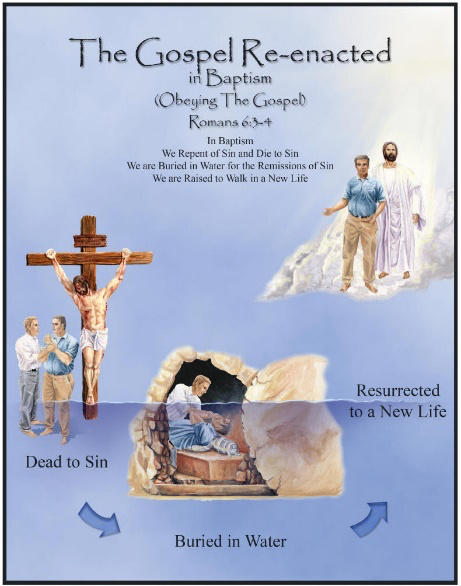
Christ’s Death, Burial, and Resurrection—And Ours - Ben Bailey
“What shall we say then? Are we to continue in sin that grace may abound? By no means! How can we who died to sin still live in it? Do you not know that all of us who have been baptized into Christ Jesus were baptized into his death? We were buried therefore with him by baptism into death, in order that, just as Christ was raised from the dead by the glory of the Father, we too might walk in newness of life” (Romans 6:1-4). At the heart and core of the Gospel are the Death, Burial, and Resurrection of Jesus Christ (1 Cor. 15:1-3). This blockbuster event is the greatest expression of love and sacrifice anyone has ever known (Rom. 5:6-8). Yet, these events also parallel the Christian’s conversion and commitment to the Savior who died for them (2 Cor. 5:14-15). Notice Christ’s Death, Burial, and Resurrection and ours.
Christ’s Death, Burial, and Resurrection—And Ours
“What shall we say then? Are we to continue in sin that grace may abound? By no means! How can we who died to sin still live in it? Do you not know that all of us who have been baptized into Christ Jesus were baptized into his death? We were buried therefore with him by baptism into death, in order that, just as Christ was raised from the dead by the glory of the Father, we too might walk in newness of life” (Romans 6:1-4). At the heart and core of the Gospel are the Death, Burial, and Resurrection of Jesus Christ (1 Cor. 15:1-3). This blockbuster event is the greatest expression of love and sacrifice anyone has ever known (Rom. 5:6-8). Yet, these events also parallel the Christian’s conversion and commitment to the Savior who died for them (2 Cor. 5:14-15). Notice Christ’s Death, Burial, and Resurrection and ours.
Christ’s Death & Mine. The Scriptures teach that Jesus died for sin (2 Cor. 5:21; 1 Peter 2:24). He suffered in his physical body so that we don’t have to face the spiritual penalty of sin (John 3:16; Isa. 53:4). The agony, torment, and pain he suffered was to free men from the slavery of sin (Rom. 6:17). In parallel to that, the Christian dies to sin when he obeys the Gospel. Paul asked the rhetorical question, “How shall we who died to sin live any longer in it” (Romans 6:2)? Of course, the answer is You Can Not. When I make the decision to obey the Gospel, I put to death my “members which are on the earth: fornication, uncleanness, passion, evil desire, and covetousness, which is idolatry” (Col 3:5). When we repent of sin, we turn from it and turn to God (1 Thess. 1:9-10). At this point, I have reenacted Christ’s death for sin by putting sin to death in my life.
Christ’s Burial & Mine. As we read the story of Jesus' death, the Scriptures next emphasize His burial. Jesus prophesied that he would not only die but be buried in the grave for three days (Mt. 12:40). And the Scriptures record that is exactly what happened (Mark 15:42-47). With this event in mind, Paul now draws a parallel between Jesus’ burial and ours when He says, “Therefore we were buried with Him through baptism into death” (Rom. 6:4). In fact, Paul would say it is at the point of our burial in water when we contact the saving death of Jesus Christ. Notice these words: “Or do you not know that as many of us as were baptized into Christ Jesus were baptized into His death?” (Rom. 6:3). Just as it was necessary for Christ to be buried in the earth to show His power over death, we must be buried with Him in water to contact His death that saves (Mark 16:16; 1 Peter 3:21; Acts 2:38). With this truth in mind, why would anyone ever want to deny the essentiality of baptism and its correlation to Jesus’ death?
Christ’s Resurrection & Mine. The climax of the Gospel story is found in Jesus’ resurrection and ultimate victory over death. The Scriptures teach this is the point at which Jesus dealt the ultimate death blow to death itself and overcame its power over mankind (Heb. 2:14-15). When Christ arose from the grave, He gave living proof to all men that He is the Resurrection and the life and whoever believes in Him will never really die (John 11:25). Just as Christ rose from the dead, the Christian also reenacts the resurrection in His obedience to the Gospel. The Holy Spirit says, “just as Christ was raised from the dead by the glory of the Father, even so, we also should walk in newness of life” (Rom. 6:4). When one comes out of the water as a new creature (2 Cor. 5:17) he now has a new outlook and a new purpose in life (Phil. 1:19-21). And, just as Jesus vanquished death through His resurrection, we have been set from the bonds of sin and death by obeying the Gospel (Rom. 6:17-18).
So What/Now What? How wonderful it is that every person who has obeyed the Gospel is a living and breathing testament to the Death, Burial, and Resurrection of our Lord and Savior Jesus Christ. Truly, we should let our light so shine before men that they may see our good works and glorify our Father who is in Heaven (Mt. 5:16). Like the Macedonians, may it be said of us “You are our epistle…known and read by all men” (2 Cor. 3:2). Also, my friend, if you have not obeyed the Gospel then the Death, Burial, and Resurrection of our Lord has not become a part of your life yet, and you are still lost in sin (Rom. 6:23). But the good news is you can do something about that today. Won’t you submit to God’s will by dying to sin (Luke 13:3), being buried with Christ in baptism (Rom. 6:1-4), and rising out of the watery grave victorious over sin and death with a new outlook on life? We hope and pray that each of us will treasure our Lord’s sacrifice by living in such a way that it brings honor to Him every day! –Ben Bailey